
News
September 2026 - Research Is Not All About Research!
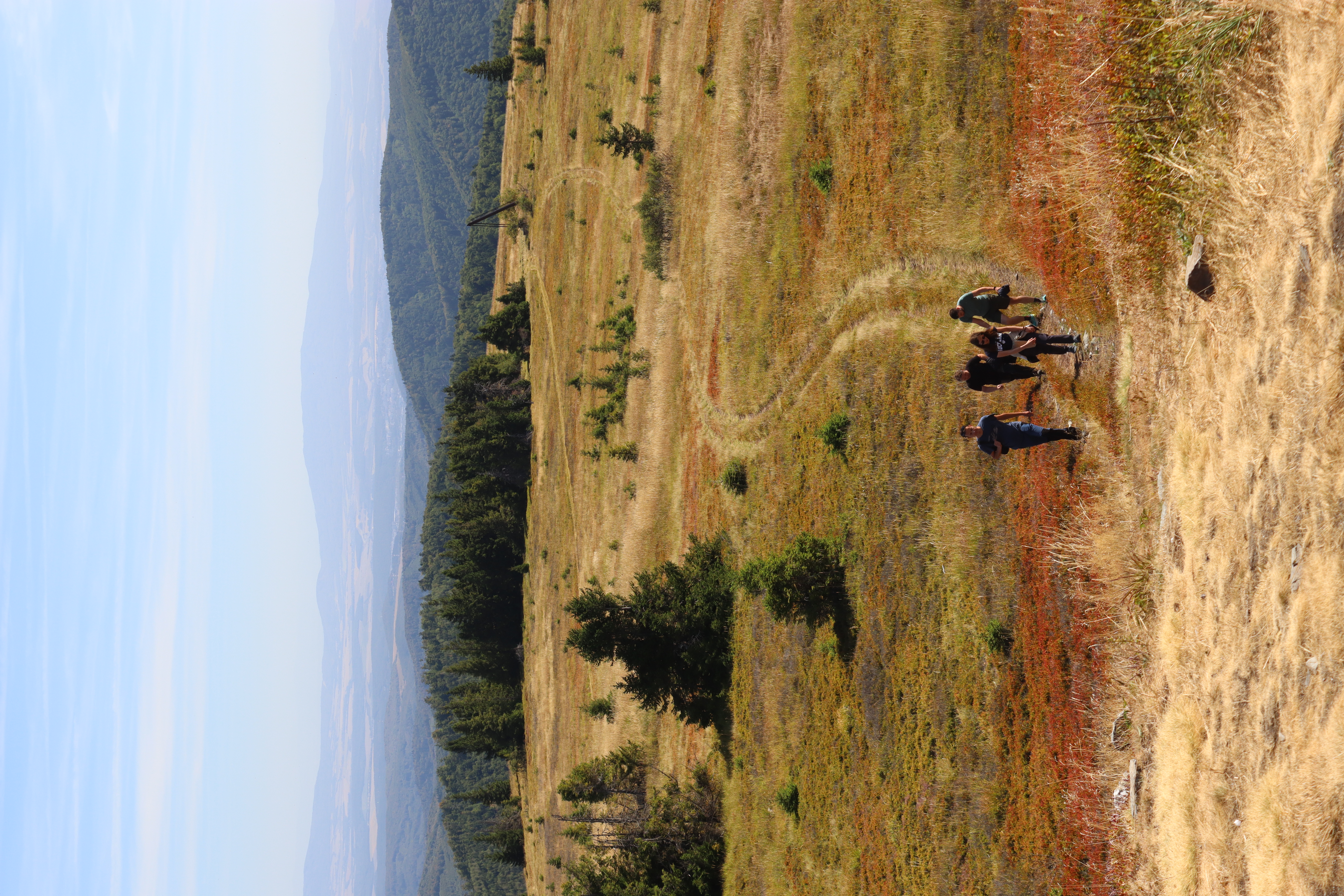
We were glad to see our team members take some time away from the lab to enjoy our sports day together.
Days like this are a good opportunity to strengthen relationships, have some fun, and recharge before getting back to the research.
Because a good team is built outside the lab too. 😊
September 2026 - Strengthening International Research Collaboration
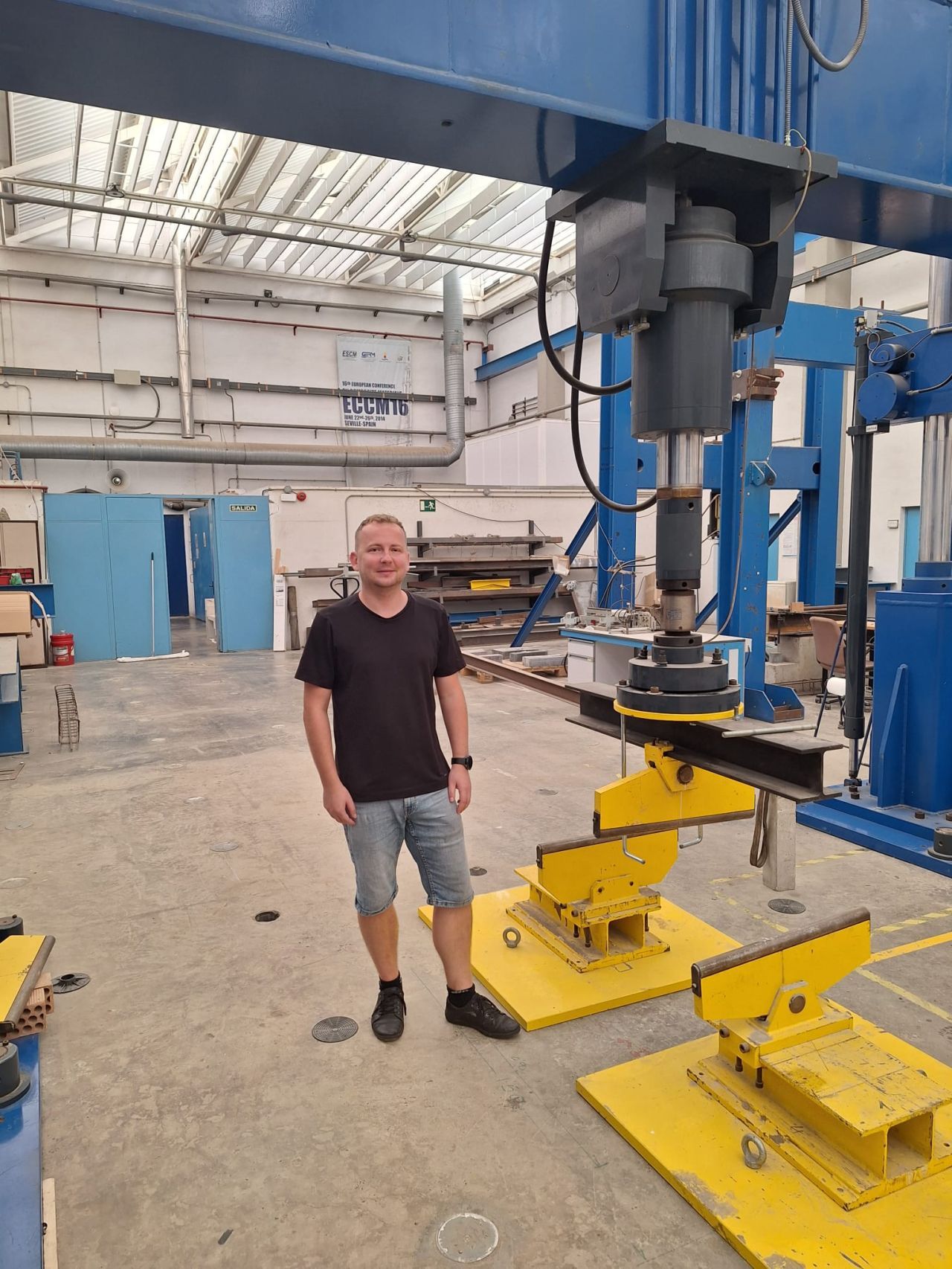
We were happy to see our colleague, Ján Perháč, representing our team during a research stay at the University of Seville.
The visit, carried out within the LASTING project supported by Ulysseus European University, brought together perspectives from computer science and structural engineering, with a focus on artificial intelligence applications in structural health monitoring.
Research exchanges like this provide an opportunity to share knowledge, explore new ideas, and develop connections that can lead to future collaboration.
We are grateful to our colleagues at the University of Seville and to Ulysseus European University for supporting opportunities that help strengthen our international research network.
September 2026 - When Traffic Becomes Input Data
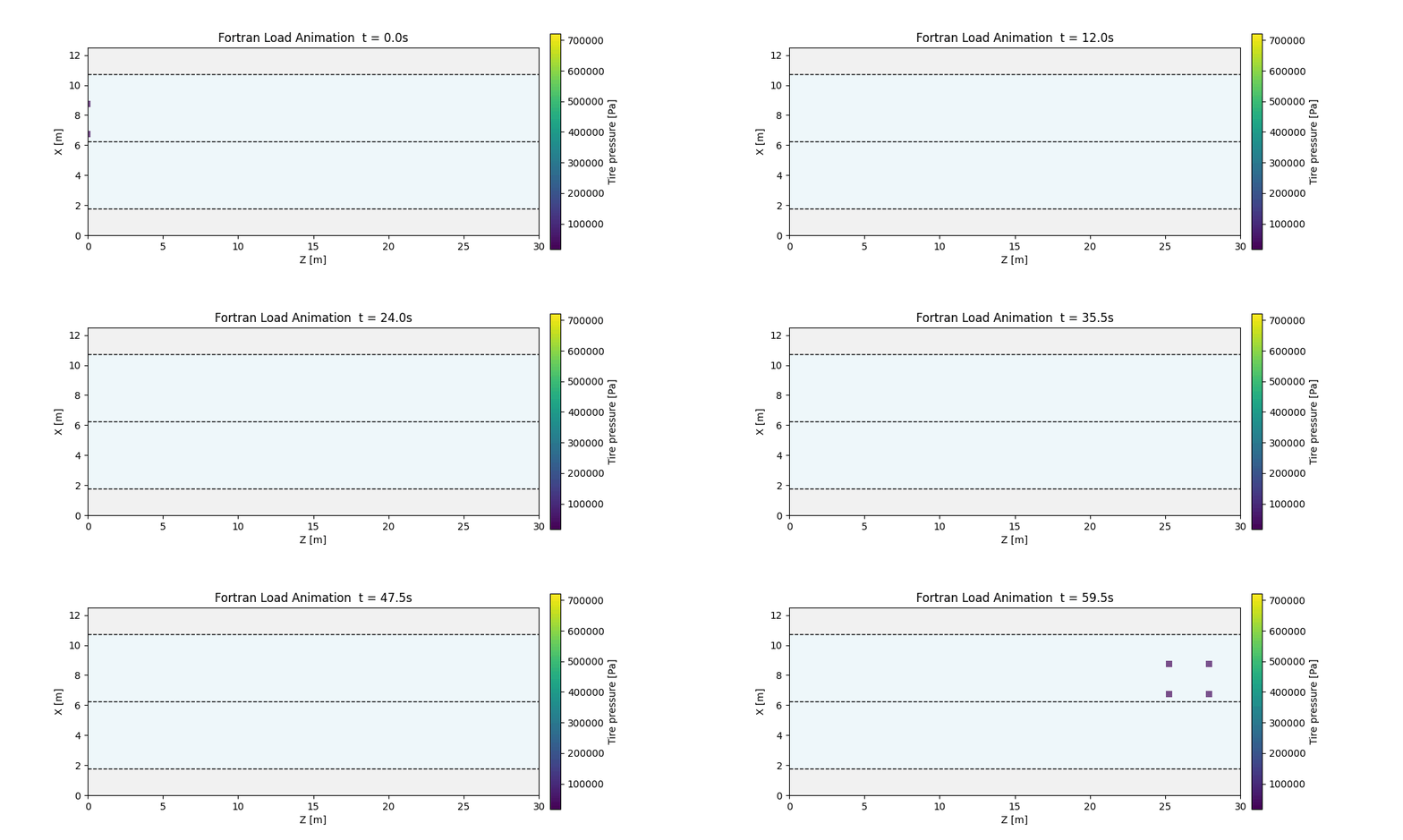
🚙 To most people, it’s traffic. To us, it’s input data.
This visualization is more than just moving dots on a bridge. It is part of our workflow for preparing realistic traffic loading for finite element simulations.
Turning real-world traffic into simulation input involves quite a bit of work behind the scenes — even if the final result is just a few seconds of animation.
Sometimes, a few seconds on screen represent hours of research.
August 2026 - Connecting Research with Engineering Practice
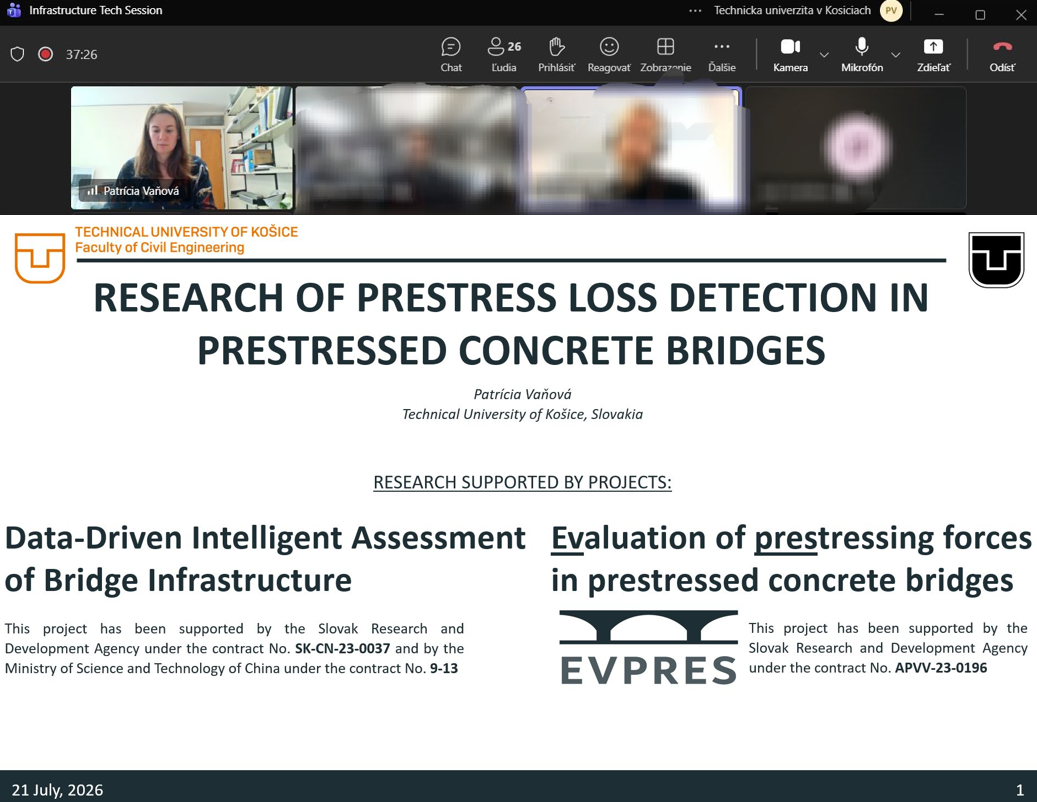
An important part of the EvPres project is connecting our research with real-world engineering practice.
We recently had the opportunity to present the EvPres project to Holmes, an internationally recognised structural engineering consultancy operating across Australia and New Zealand.
The discussion provided a valuable opportunity to share our research, exchange ideas with industry professionals, and hear different perspectives on structural health monitoring and its practical applications.
We are grateful to Claire Pascua for the kind invitation and for giving us the opportunity to present our work and discuss how research and engineering practice can support each other.
August 2026 - Growing Through International Collaboration
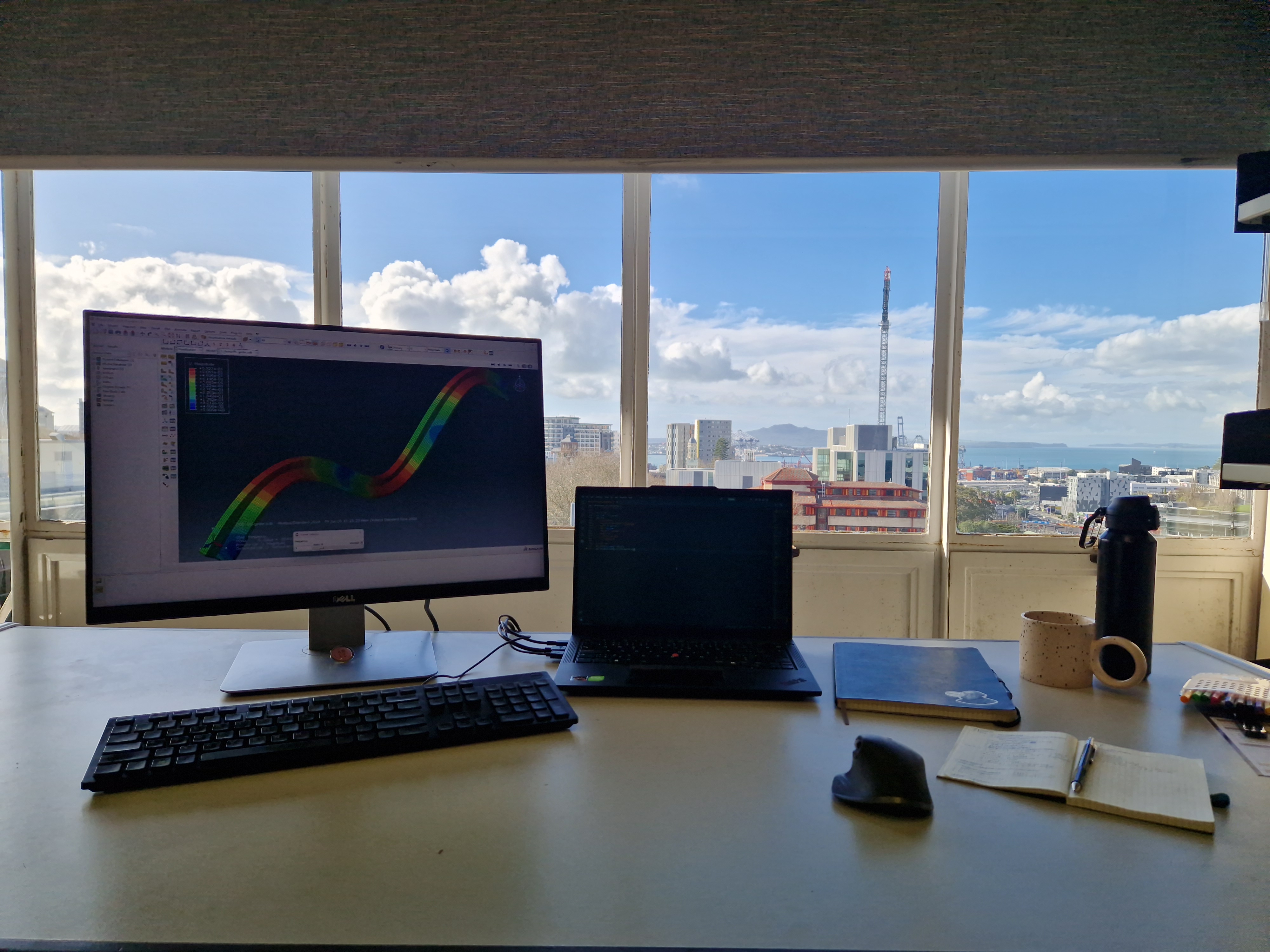
The EvPres project continues to benefit from international research collaboration.
Over the course of six months, our team member had the opportunity to join the University of Auckland as a visiting researcher. The research stay provided valuable opportunities to exchange ideas, learn from different approaches, and develop new connections within the structural engineering and research community.
We are especially grateful to Quincy Ma for his guidance, support, and encouragement throughout the visit. The knowledge and ideas developed during the stay will contribute to the ongoing work of the EvPres project and help strengthen our collaboration with the University of Auckland.
We are also grateful to everyone at the University of Auckland who made the visit such a positive experience.
International research stays such as this are an important part of building a strong research network and bringing new perspectives back into our work.
July 2026 - Advancing Women in Engineering & Construction (AWEC) Symposium
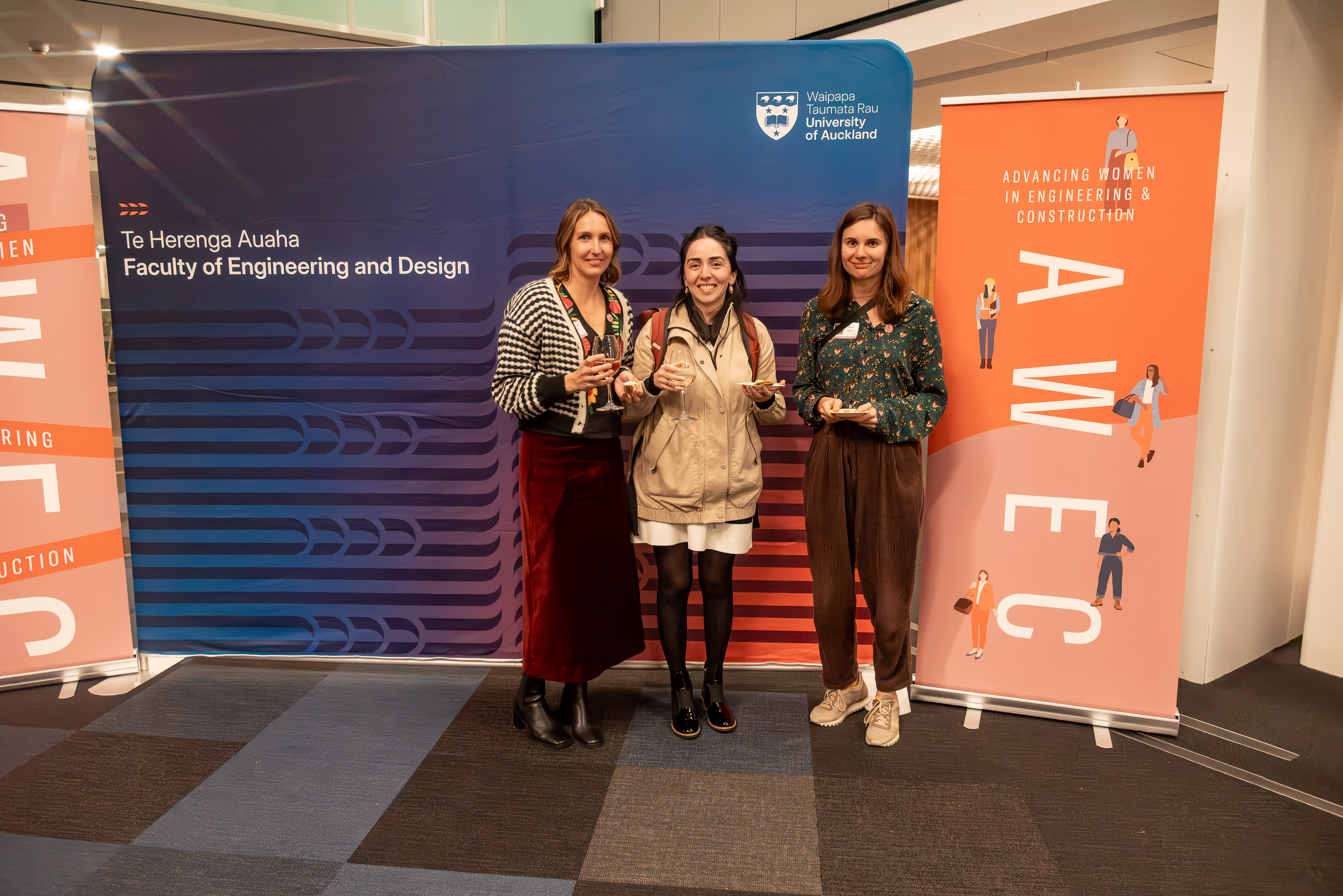
We were pleased to see our Principal Investigator take part in the Advancing Women in Engineering & Construction (AWEC) Symposium.
The symposium brought together researchers, industry professionals, and leaders to discuss experiences and ideas for building a more diverse, inclusive, and supportive engineering community.
Events such as this provide a valuable opportunity to exchange perspectives, connect with others in the field, and reflect on how we can contribute to a stronger engineering community.
July 2026 - The First Seeds of Our Research
We are happy to see the first seeds of our research published.
Our paper represents one of the first scientific outcomes related to the EvPres project. While the study is preliminary, it has already helped us better understand what is needed to prepare reliable, high-quality databases for our future work.
Careful data preparation will be an important foundation for the numerical analyses and data-driven models that will follow. Understanding these requirements early allows us to build a stronger basis for the next stages of the project.
Every research project starts with small steps, and this is one of ours.
July 2026 - A First Step into Structural Health Monitoring
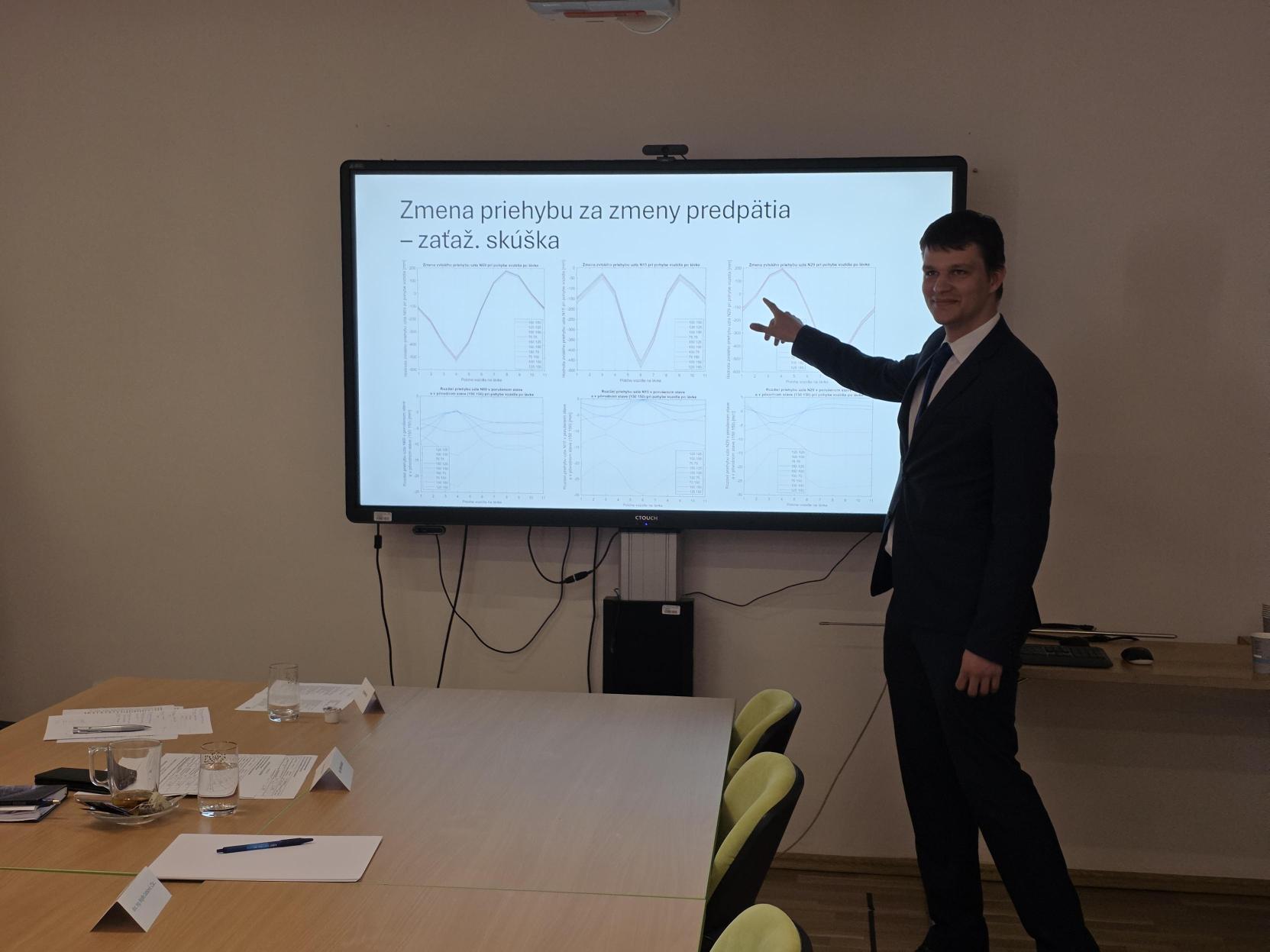
We are happy to celebrate an important milestone for Jozef, who successfully defended his Bachelor’s thesis with the highest marks.
His thesis, “Influence of Prestress Variation in Bearing Cables on the Structural Deformation of a Suspension Bridge,” focused on the challenging topic of prestress loss and its influence on structural behaviour.
For us, it was especially encouraging to see a young engineer take on a topic closely connected to structural health monitoring. Research journeys often begin with small steps, and getting involved early provides an opportunity to learn, explore new ideas, and gradually build a deeper understanding of complex problems.
Jozef has shown great enthusiasm throughout his work, and we hope this is only the beginning of his research journey.
Congratulations, Jozef, and all the best for what comes next!
June 2026 - Sharing Our Research with the Structural Engineering Community
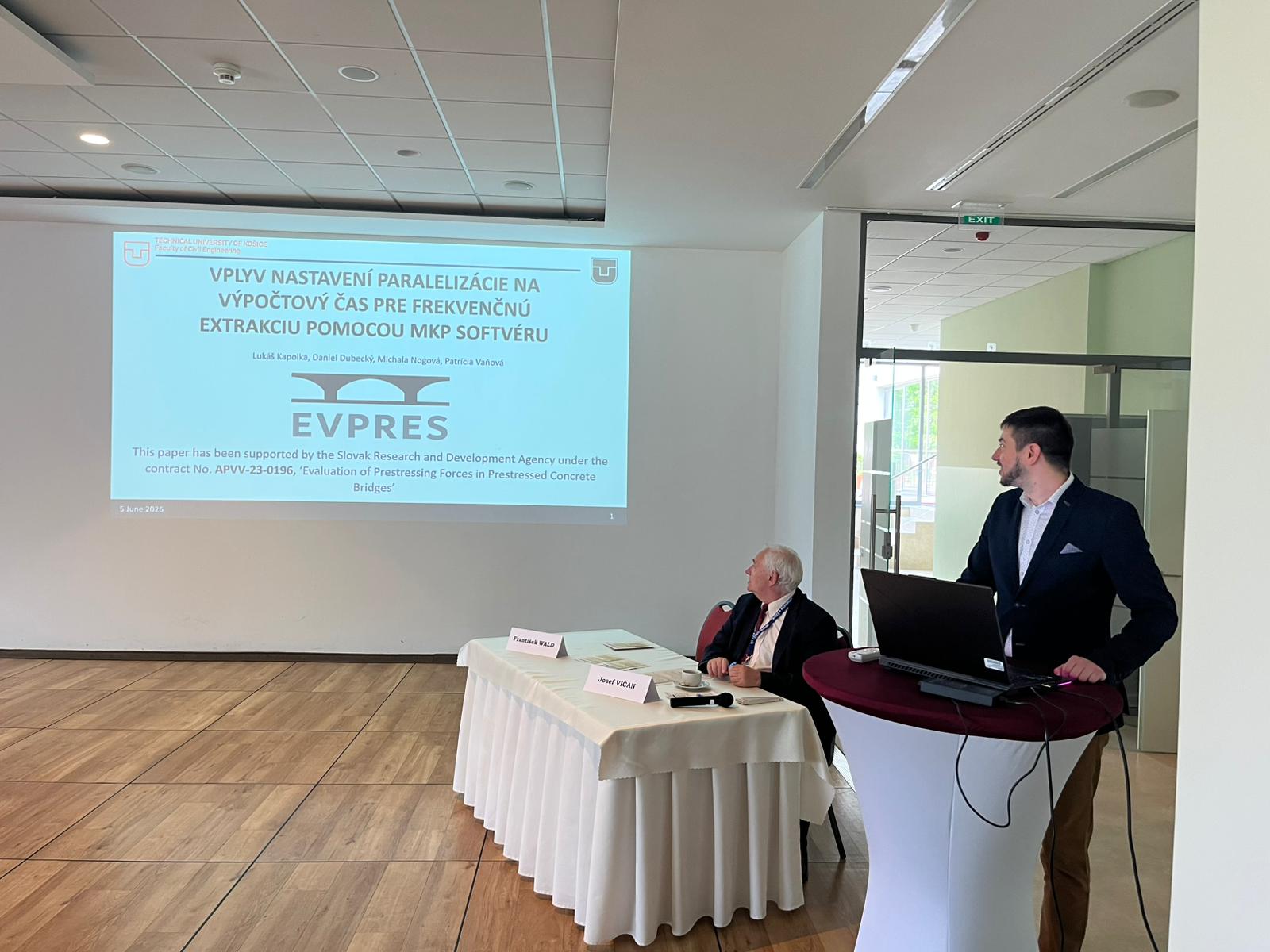
Our research was presented at the 49th Meeting of Slovak and Czech Steel Structures Professionals in Dolný Kubín, Slovakia.
Štefan and Lukáš represented the EvPres team and presented our latest findings to an audience of researchers and professionals working in structural engineering.
Conferences and professional meetings such as this provide an opportunity to discuss ongoing research, exchange experiences, and connect academic work with engineering practice.
We are glad to see our research reaching beyond the laboratory and becoming part of the wider structural engineering community.
May 2026 - The End of the Experimental Campaign
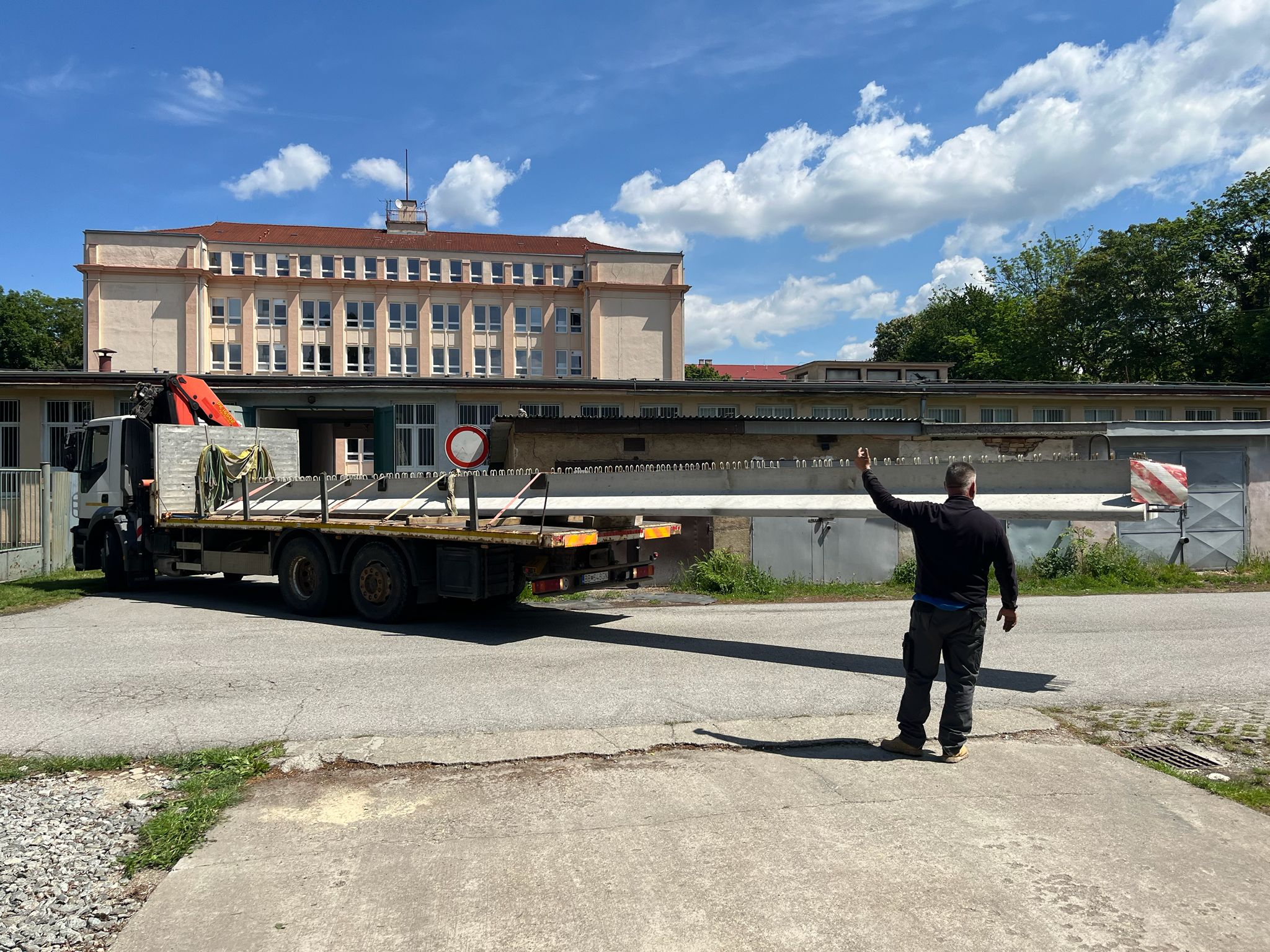
After months of testing, it was finally time to say goodbye to our beams.
Throughout the experimental campaign, our prestressed concrete specimens went through modal testing, loading, instrumentation, controlled damage, and plenty of long days in the laboratory.
The beams may no longer be with us, but the data collected from them will remain an important part of the EvPres project and will continue to support our numerical analyses and future research.
A slightly bittersweet end to a very productive experimental campaign. 😢
May 2026 - Recognition for a Lifetime of Contributions
We are pleased to share that our team member, mentor, and colleague, Prof. Vincent Kvočák, has been recognized by Slovakia’s national broadcaster, STVR, for his lifetime of work and contributions to structural engineering.
Throughout his career, Prof. Kvočák has contributed to bridge engineering and structural research, while also sharing his knowledge and experience with generations of students, researchers, and engineers.
Although now retired, his influence continues to be felt within our team and across the wider engineering community. His experience, guidance, and dedication have left a lasting mark on the people and research around him.
Congratulations on this well-deserved recognition, and thank you for everything you have contributed to structural engineering and to our team.
April 2026 - EvPres at NZSEE 2026
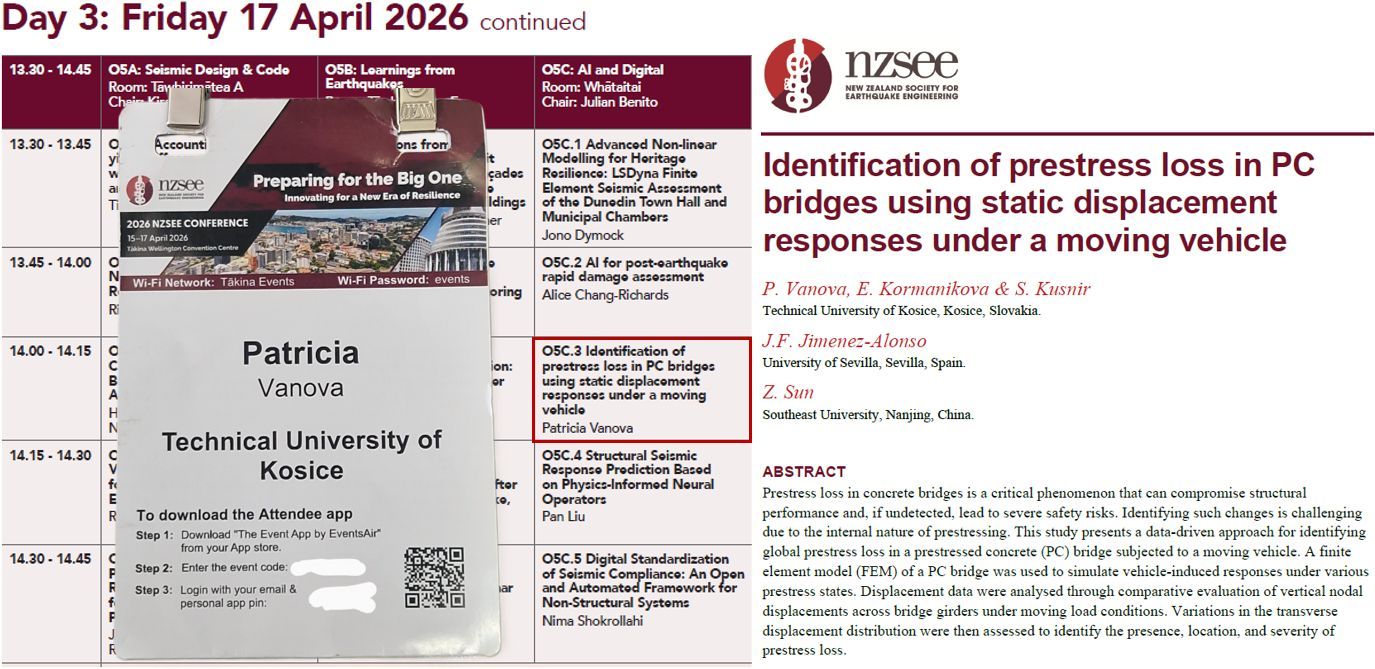
The EvPres project was presented at the New Zealand Society for Earthquake Engineering (NZSEE) Conference 2026.
Prestress loss is an important concern for prestressed concrete structures, as changes in prestressing force can influence structural behaviour over time. Its early detection is particularly relevant in seismically active regions, where maintaining reliable structural performance is essential for resilience and safety.
The conference provided a valuable opportunity to share our research with the New Zealand earthquake engineering community and to exchange ideas with researchers and practitioners working in the field.
We are grateful for the discussions and new perspectives that will help us continue developing the EvPres project.
March 2026 - Putting Our Beam to the Test
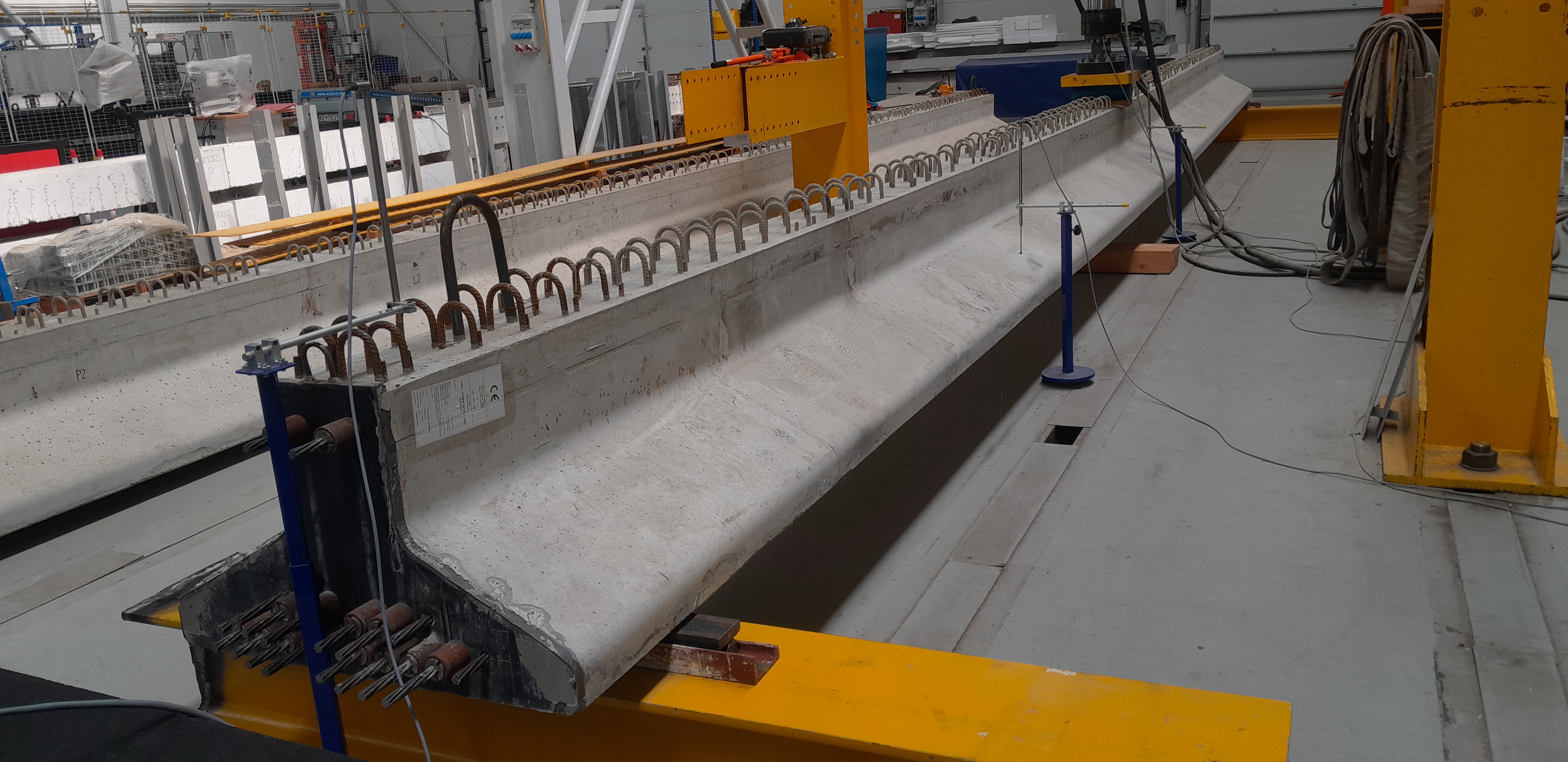
As part of the EVvPres project, we carried out three-point bending tests on our prestressed concrete beams.
During the tests, we carefully monitored the applied load and the resulting displacement to capture how the beam responded as the load increased.
The experimental data provide an important reference for comparing the behaviour of the physical beam with our theoretical and numerical models.
Another step in connecting what we simulate with what happens in the laboratory.
February 2026 - What Does Prestress Loss Look Like?
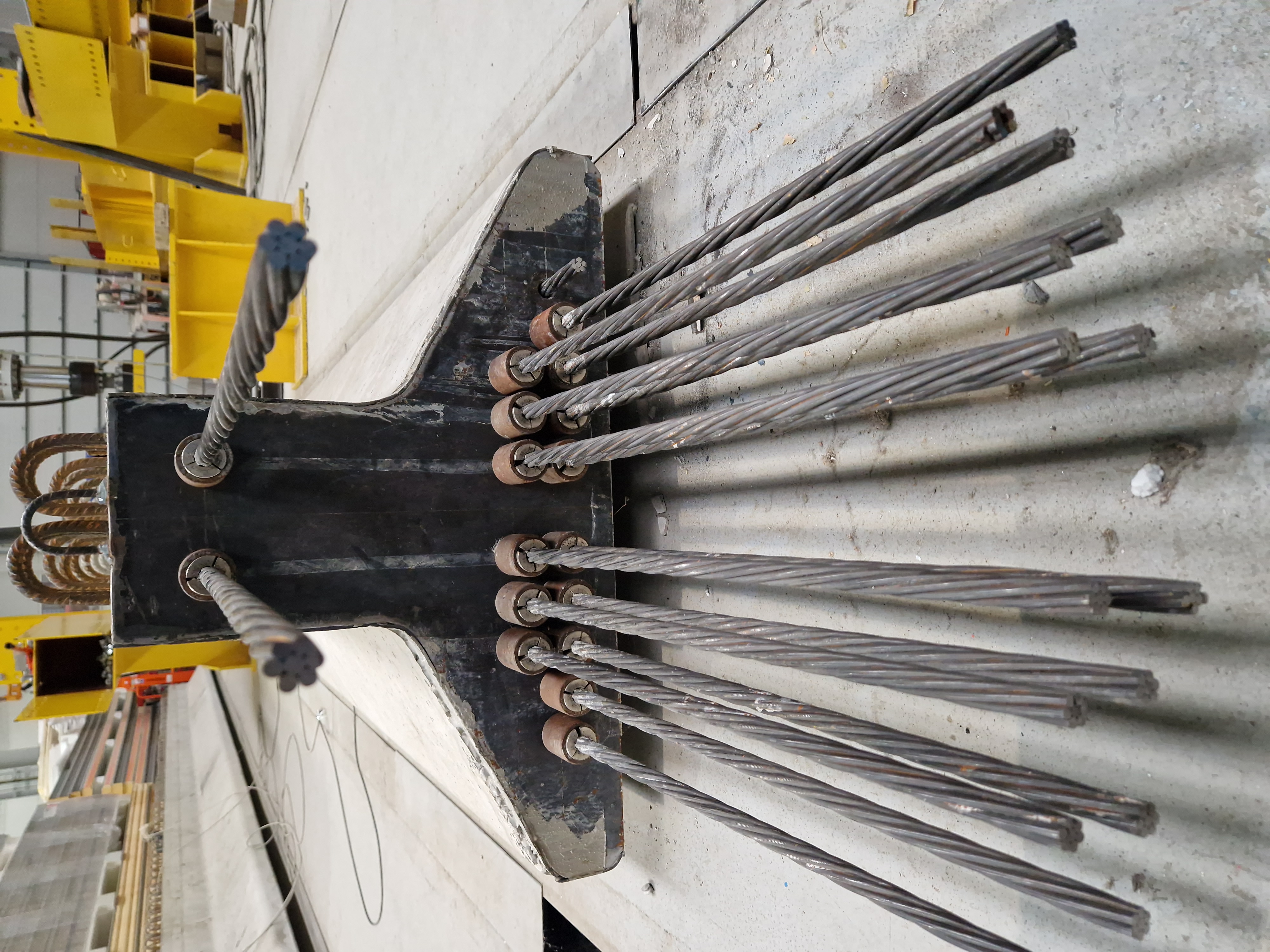
What does prestress loss look like?
This image shows the end of one of our prestressed concrete beams after the anchorage was deliberately released, creating a localized loss of prestressing force.
Introducing this controlled damage state is an important part of our experimental program. It allows us to investigate how a change in prestress affects the dynamic behaviour of the beam and whether such changes can be detected through vibration-based structural health monitoring.
Sometimes, to understand how damage can be detected, we first have to create it.
January 2026 - When Your Job Description Includes Hitting a Beam with a Hammer
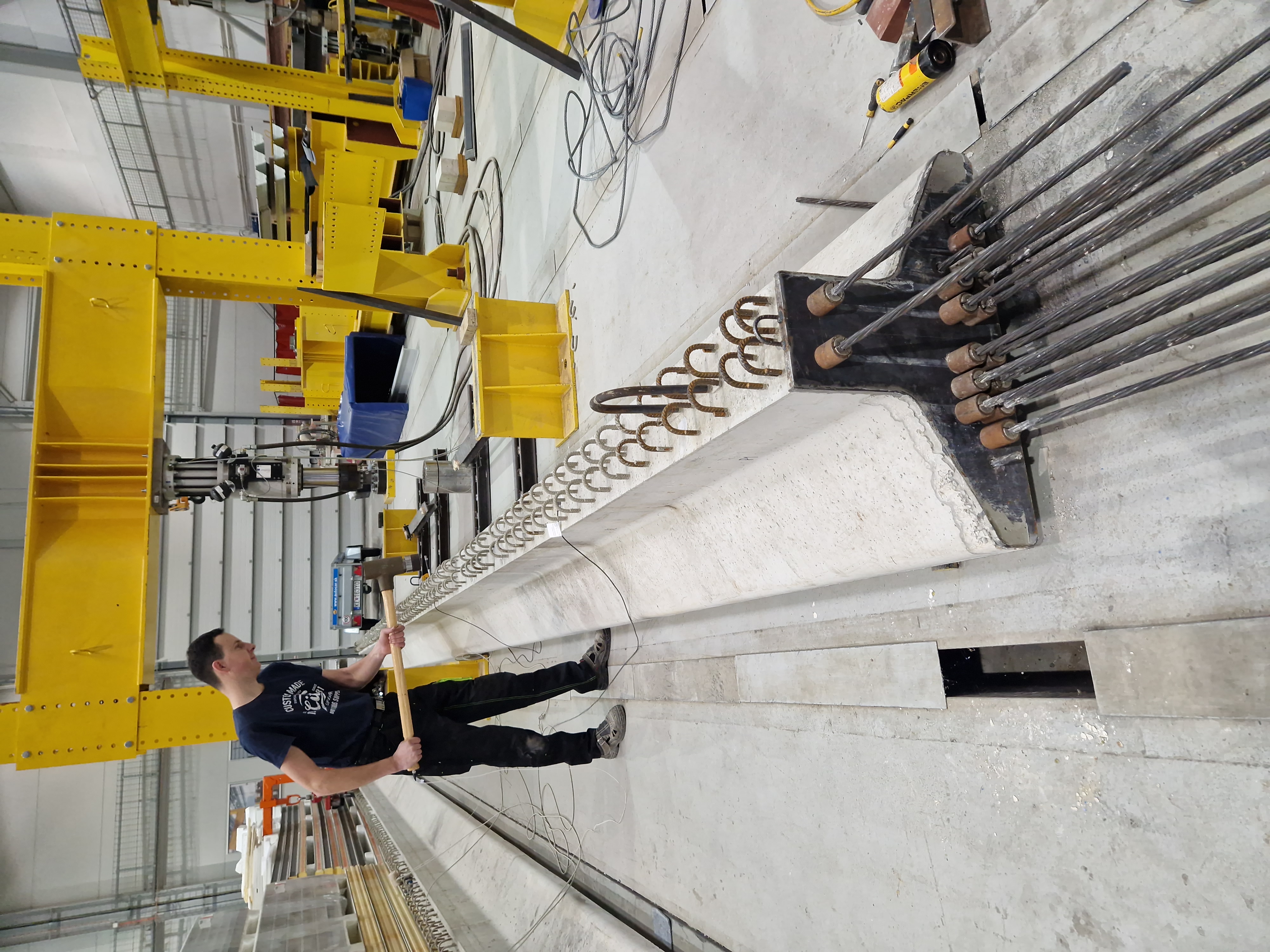
When your job description includes hitting a beam with a hammer, you know you’re working in experimental structural engineering.
During our January testing, we used impact hammer excitation to investigate the dynamic characteristics of one of our prestressed concrete beams. By introducing a controlled impact and observing the resulting response, we can learn more about the dynamic behaviour of the structure.
It may look like we’re simply hitting a beam with a hammer, but there is a lot of science behind that little impact.
Fortunately, the beam knew it was for science. 😄
November 2025 - EvPres at ICVE 2025
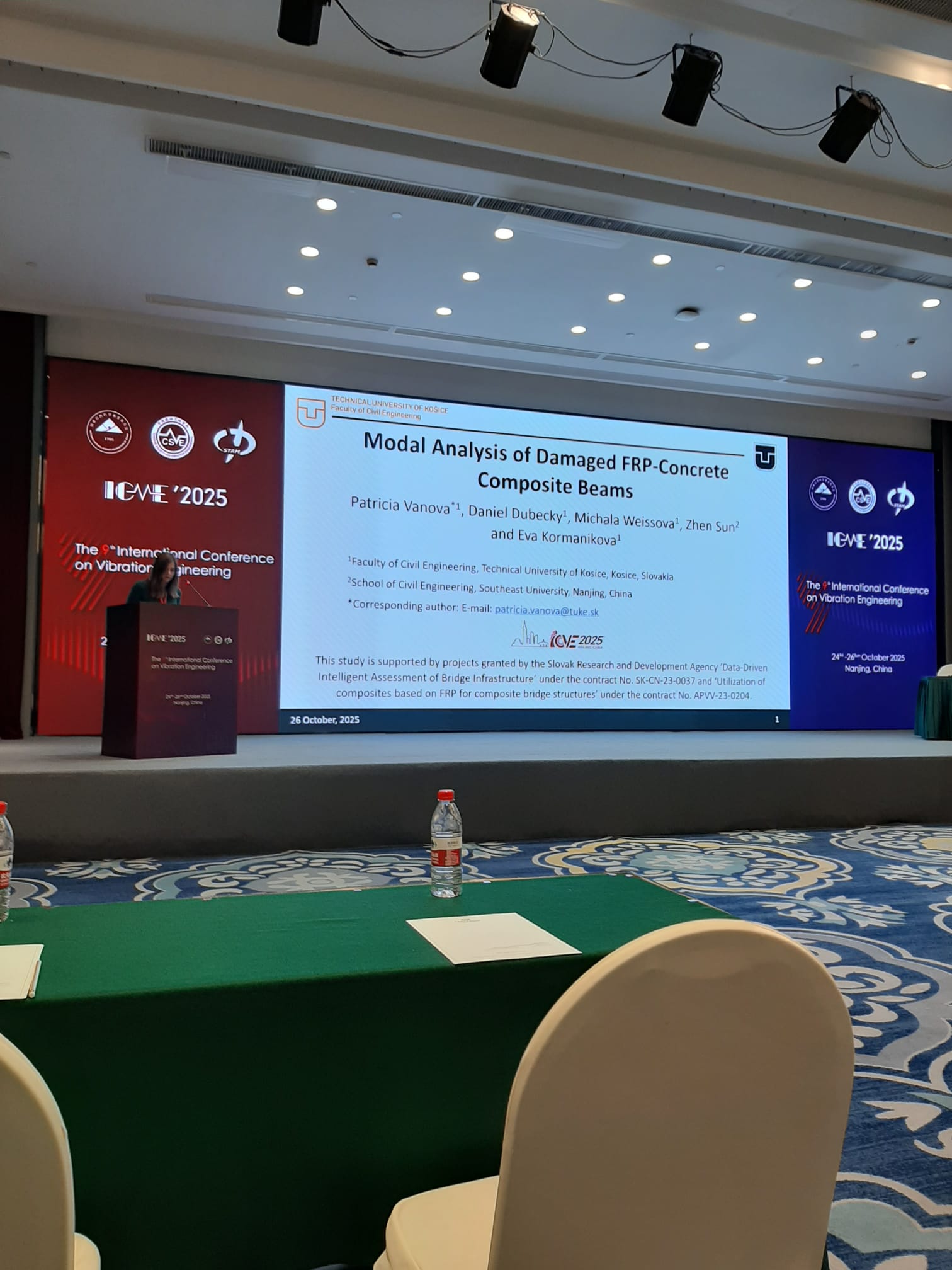
From October 24–26, our team participated in the 9th International Conference on Vibration Engineering (ICVE 2025) in Nanjing, China.
The conference brought together researchers working in vibration engineering and related fields from around the world. It was a valuable opportunity to present our research, learn about recent developments in the field, and exchange ideas with other researchers.
For EVPRES, such opportunities are an important part of developing our research and connecting our work with the wider scientific community.
We are grateful for the discussions, new perspectives, and inspiration that we brought back from Nanjing.
November 2025 - A Successful PhD Defense

We are happy to celebrate an important milestone for our team member, Michala Weissová, who has successfully defended her doctoral dissertation this August.
Completing a PhD is a significant achievement, marking years of research, learning, and persistence. We are especially glad that Michala will continue her research career at the Technical University of Košice.
Her work and experience will remain connected with the EvPres project, and we look forward to continuing our collaboration and seeing what comes next in her research journey.
Congratulations, Michala, and all the best for the next chapter!
October 2025 - First Project Outcomes Published
We are happy to see the first outcomes of our project making their way into the scientific literature.
Our paper, “Application of Sparse Autoencoder to Damage Detection of a Model Steel Truss Bridge,” was presented by Patrícia Vaňová at the EVACES 2025 Conference and has now been published as part of the Experimental Vibration Analysis for Civil Engineering Structures proceedings. The paper was co-authored with Javier Fernando Jiménez-Alonso and Zhiyu Jiang.
The study explores the use of a sparse autoencoder for damage detection in a model steel truss bridge, connecting our work in structural dynamics with data-driven approaches to structural health monitoring.
This is one of the first published outcomes of the EvPres project and an encouraging step as we continue developing our research.
October 2025 - EVPRES Research at SPACE Conference 2025
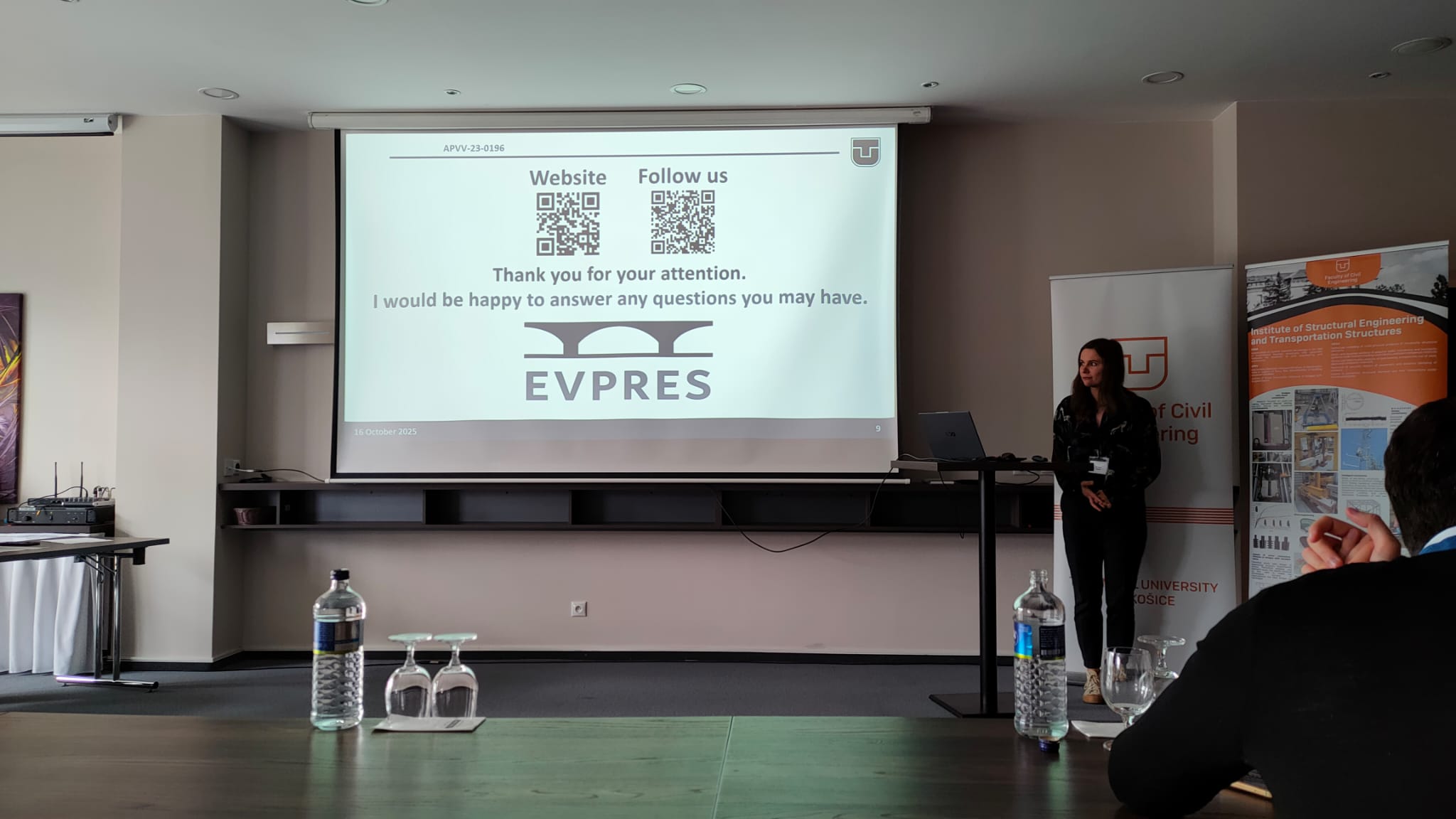
In October, our research was presented at the SPACE Conference 2025 by Patrícia Vaňová.
The presented paper, “Impact of Parallelization Settings on Computational Time in Modal Analysis Using FEM Software,” looks at the computational demands of modal analysis and the influence of parallelization on the time required for large-scale numerical simulations.
Understanding these computational requirements is an important part of our work, as efficient numerical modelling becomes increasingly important when dealing with complex structural analyses and large datasets.
This study is another step towards making the computational side of the EVPRES research more efficient and practical.
September 2025 - A New Master’s Student Joins EVPRES
The EvPres team is growing, and we are happy to welcome Tomáš, who has joined us as a Master’s student.
His thesis, “Structural Health Analysis of Prestressed Concrete Beams with Respect to Prestress Variations,” is closely connected to our ongoing research on prestressed concrete structures and structural health monitoring.
Through his work, Tomáš will explore how variations in prestress can influence the behaviour of prestressed concrete beams, contributing another perspective to our research.
We are looking forward to following his progress and seeing where his work takes him!
August 2025 - A Farewell to a Mentor
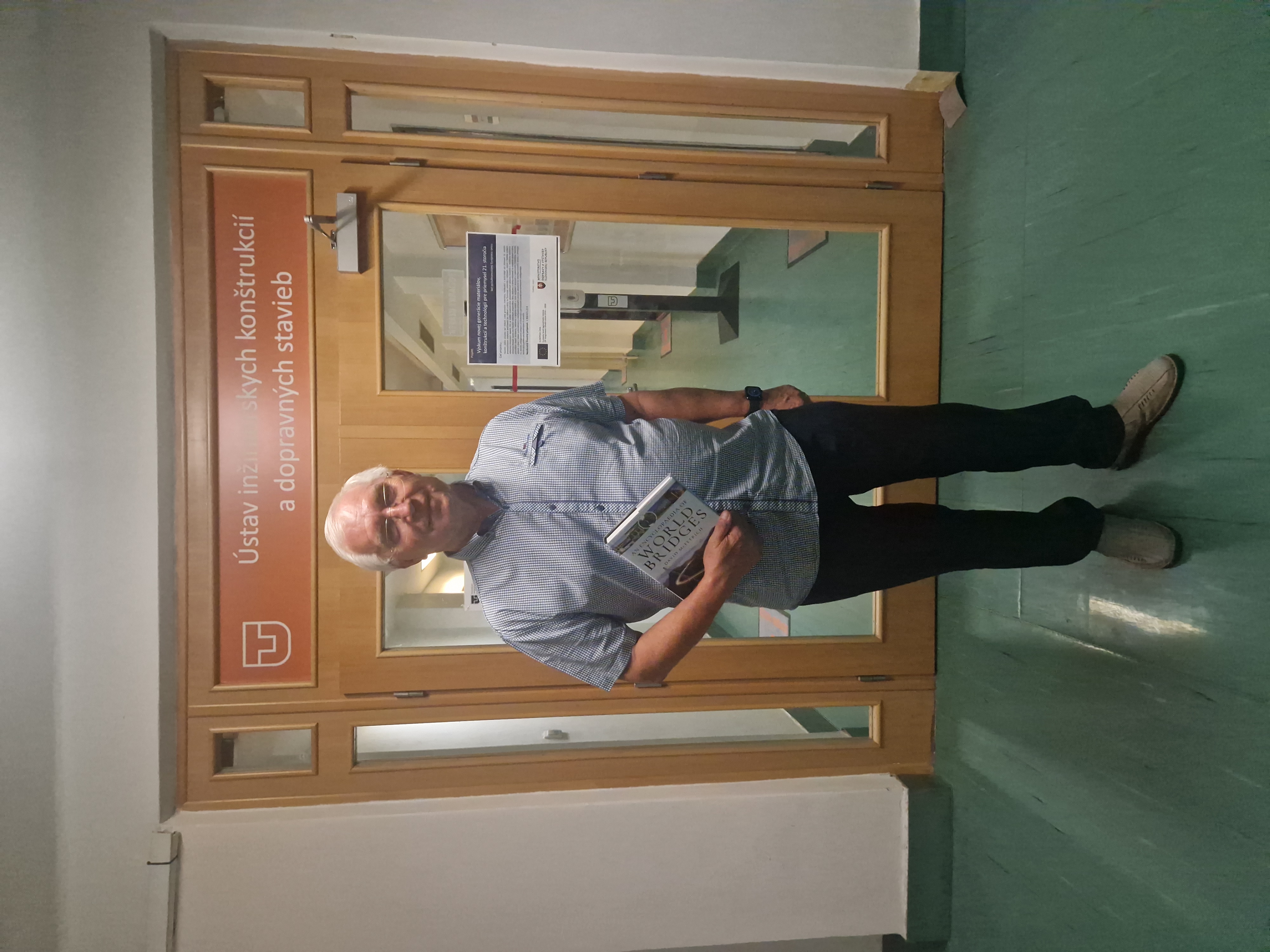
Some moments in research are not about experiments, results, or publications. They are about the people who have helped shape our journey.
This month, we said farewell to Prof. Kvočák as he retired from his long career in academia and structural engineering. As a researcher, bridge engineer, supervisor, and mentor, he has made a lasting contribution to our department and to generations of students and colleagues.
We are grateful for his guidance, experience, and the knowledge he has shared with us over the years. His influence will remain a part of our work long after his retirement.
We wish him all the best for the next chapter!
August 2025 - A Technical Trip to Prestressed Concrete Bridges
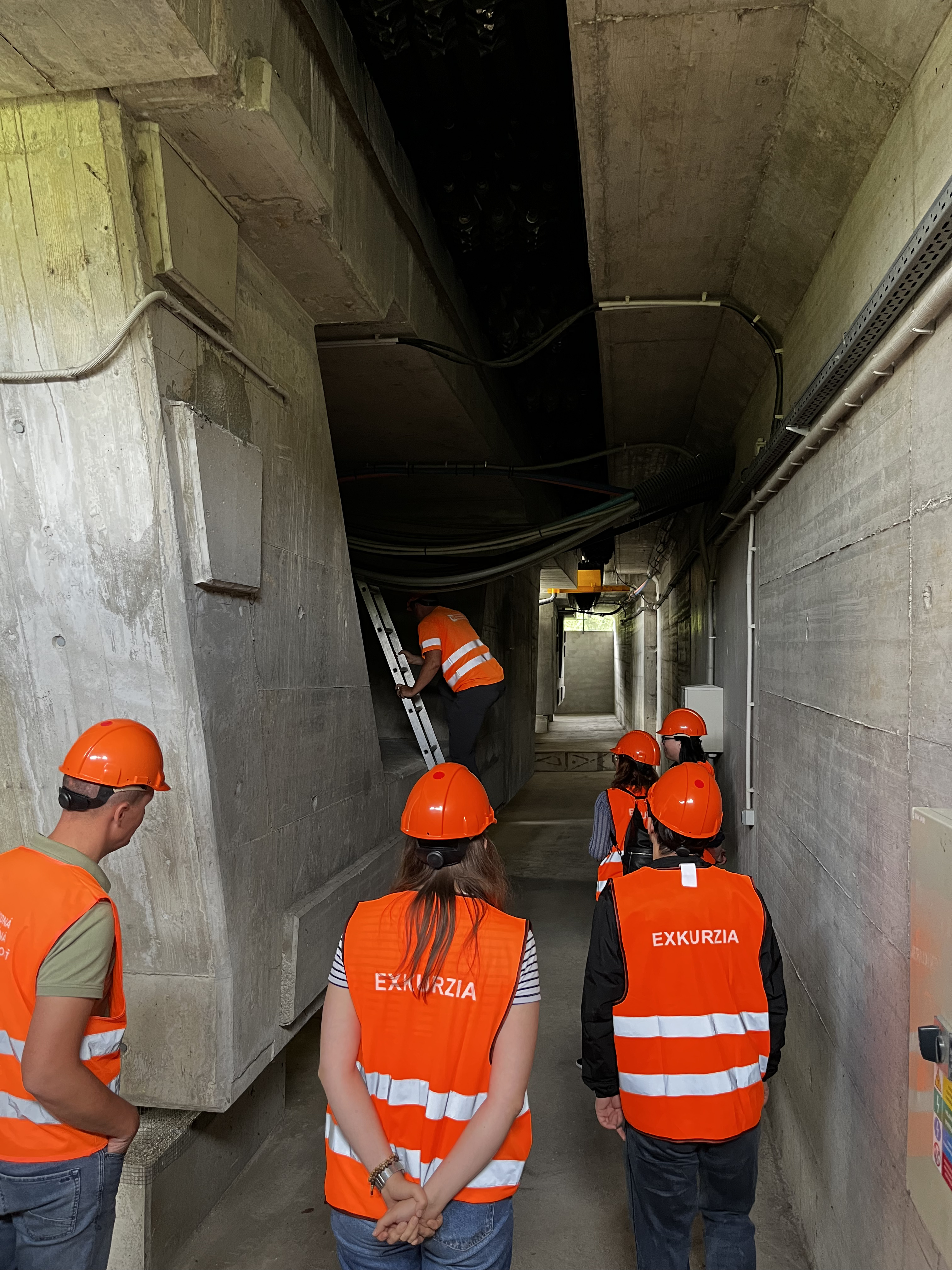
As part of our research on prestressed concrete structures, the EvPres team took a technical trip to visit several prestressed concrete bridges in Slovakia.
Seeing these structures in the field gave us an opportunity to look beyond drawings and numerical models and better understand how prestressed concrete bridges are designed, constructed, and maintained in practice.
The visit also helped us connect what we study in the laboratory and in our simulations with real structures that have been carrying traffic for years.
Sometimes, a good research day means stepping away from the computer and taking a closer look at the structures themselves.
August 2025 - We’re not forgetting to have fun while researching!
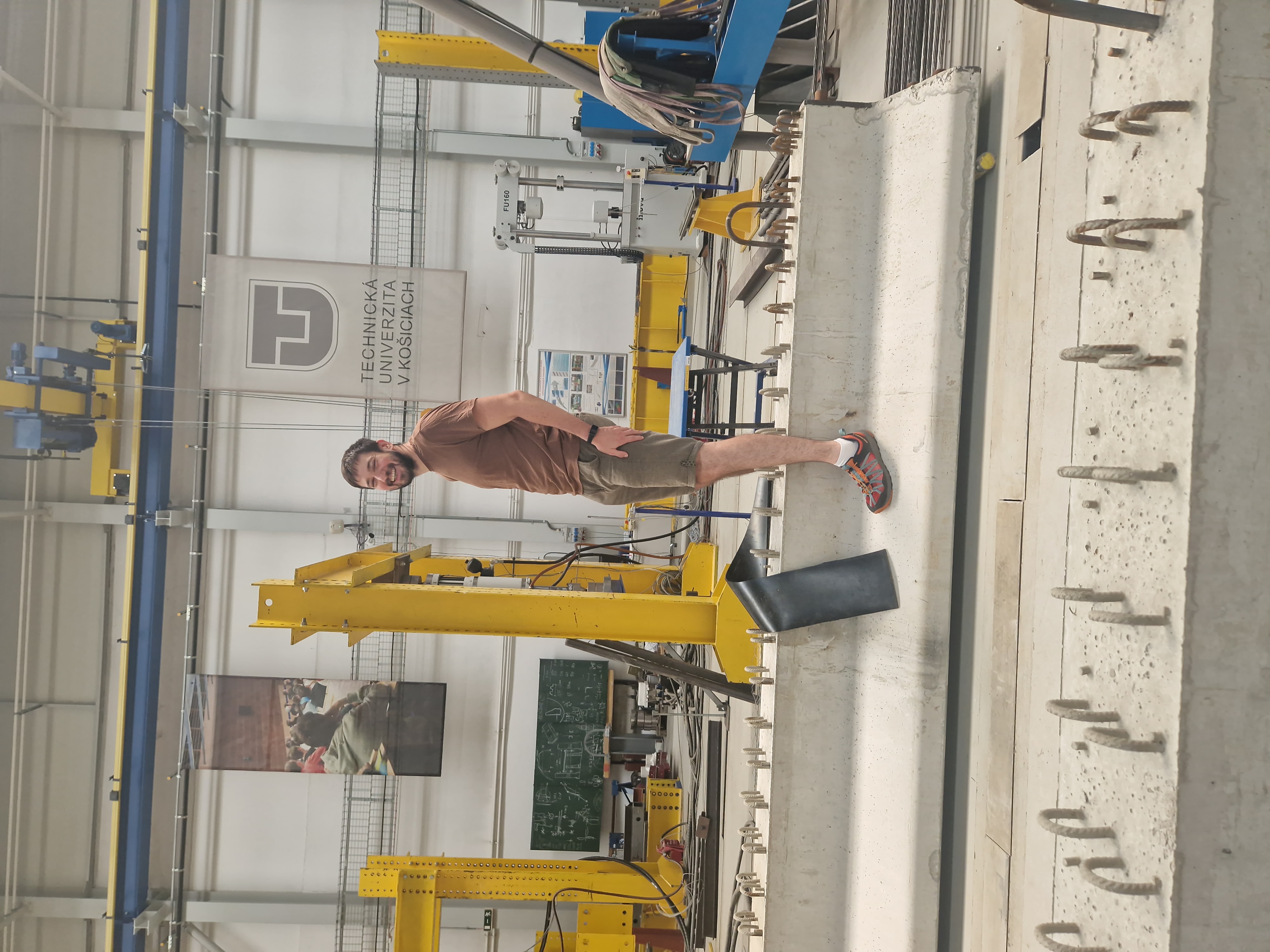
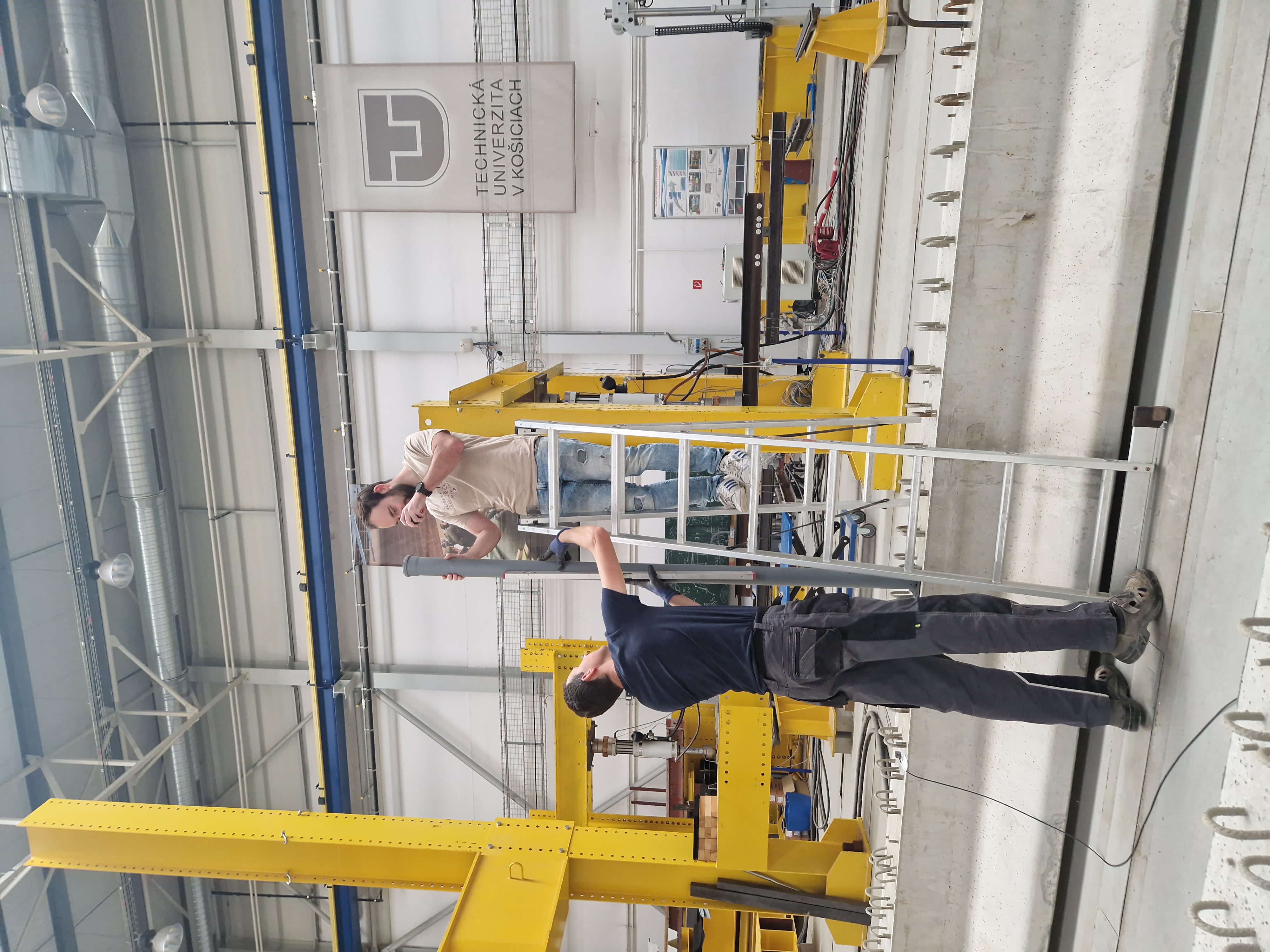
Whether it’s standing on beams or dropping metal balls from ladders, our team is all in — with science, safety, and smiles.
At EvPres, we believe that curiosity, collaboration, and a bit of laughter are just as important as data and results.
July 2025 - Our research is reaching new heights — literally!
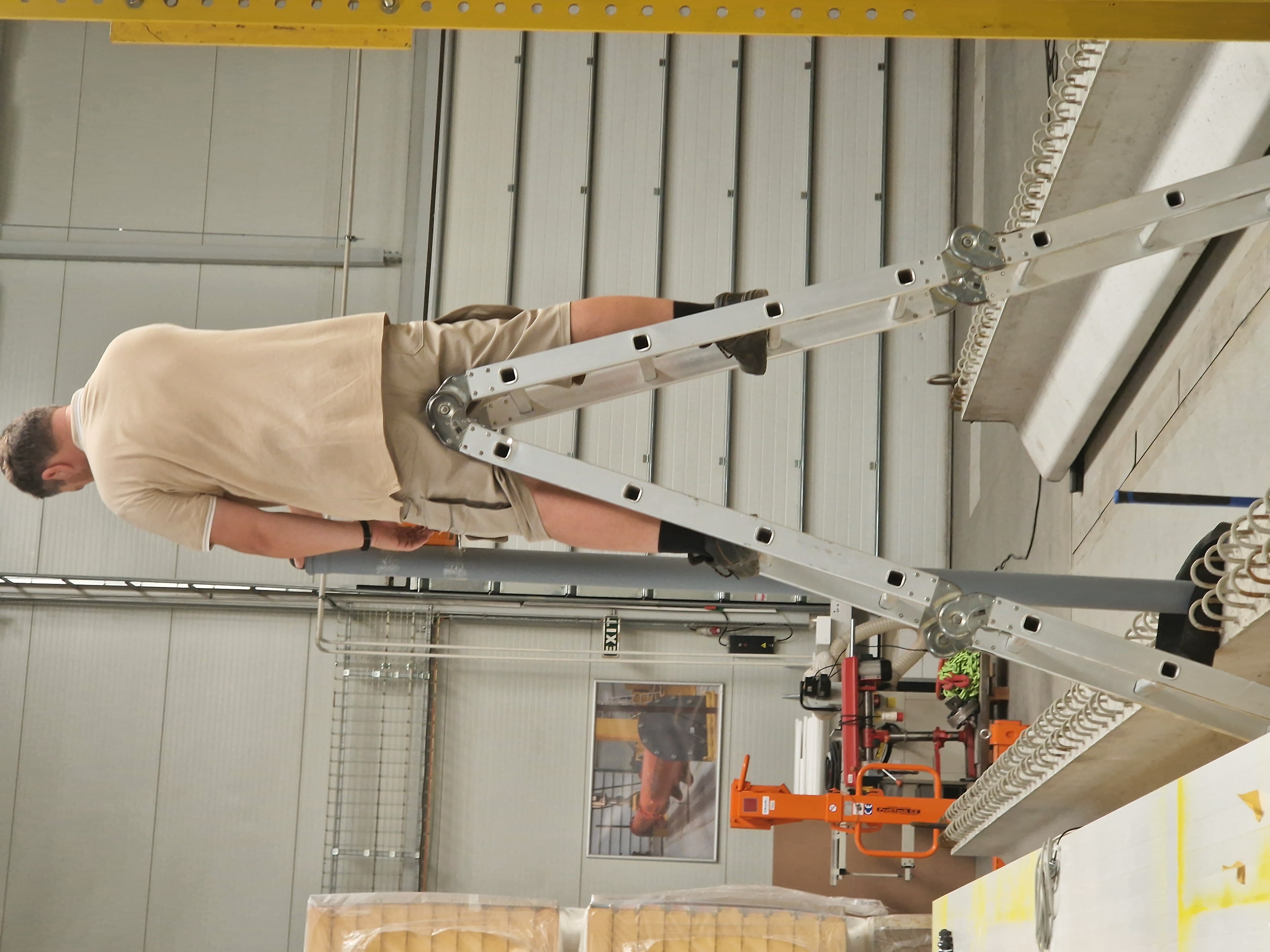
As part of our ongoing experimental work, we performed a preliminary modal analysis using impact excitation from a dropped metal ball at Technical University of Košice’s lab. This simple yet effective method helps us observe the dynamic response of the structure and extract its natural frequencies and mode shapes.
Big thanks to our colleague for going the extra (ladder) step to get the job done safely and accurately!
July 2025 - IAESTE intern
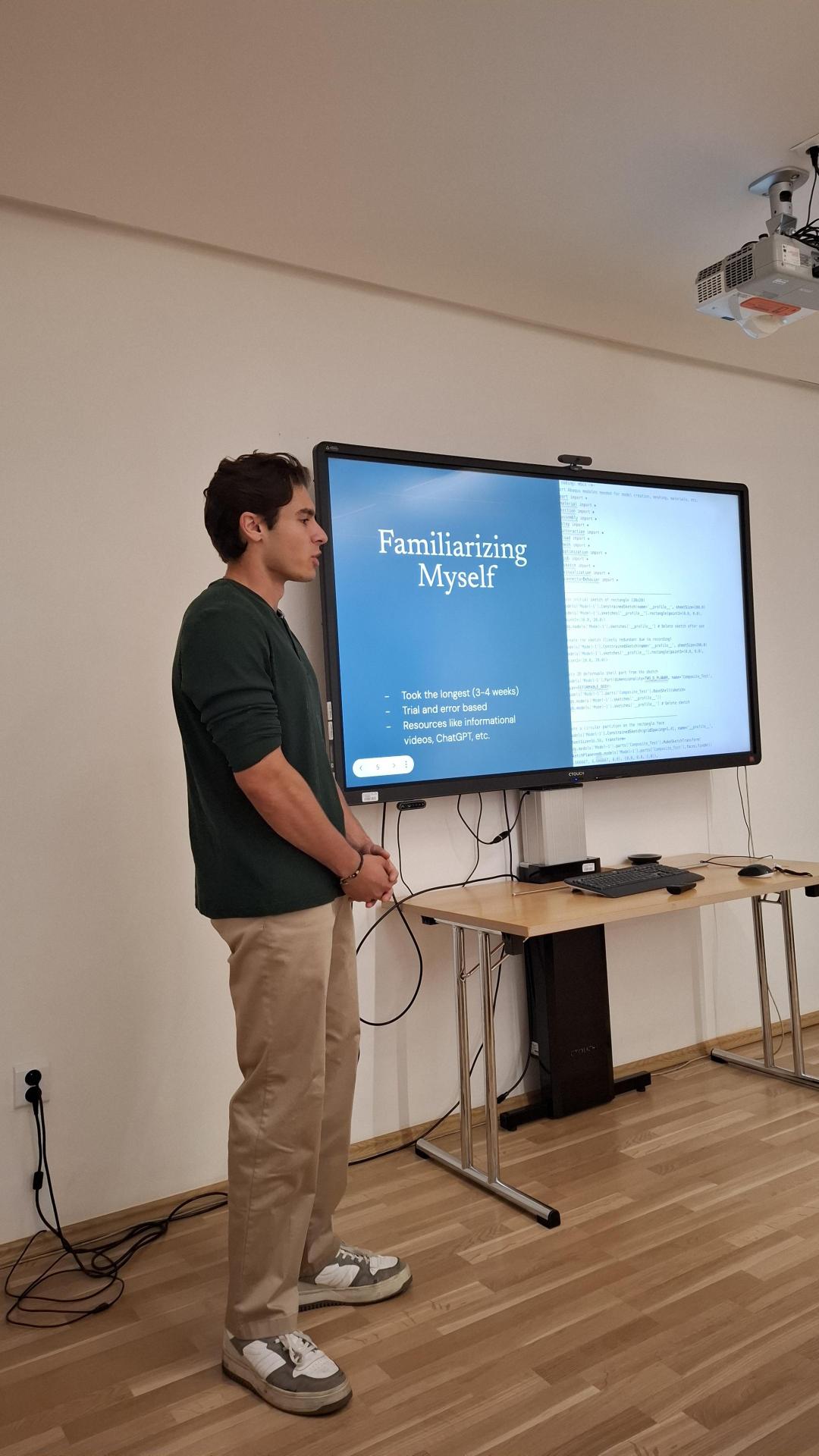
For 8 weeks, from mid-May to mid-July, our team had the pleasure of welcoming an IAESTE intern at Technical University of Košice as part of our ongoing international collaboration efforts.
We were happy to host John Witczak, who contributed significantly to the development of Python code for our prestress loss database — an important part of our work in structural analysis and research.
We’d like to sincerely thank John for his tremendous help, dedication, and great energy throughout his stay. Wishing him all the best in his future endeavors!
July 2025 - Material Properties Testing
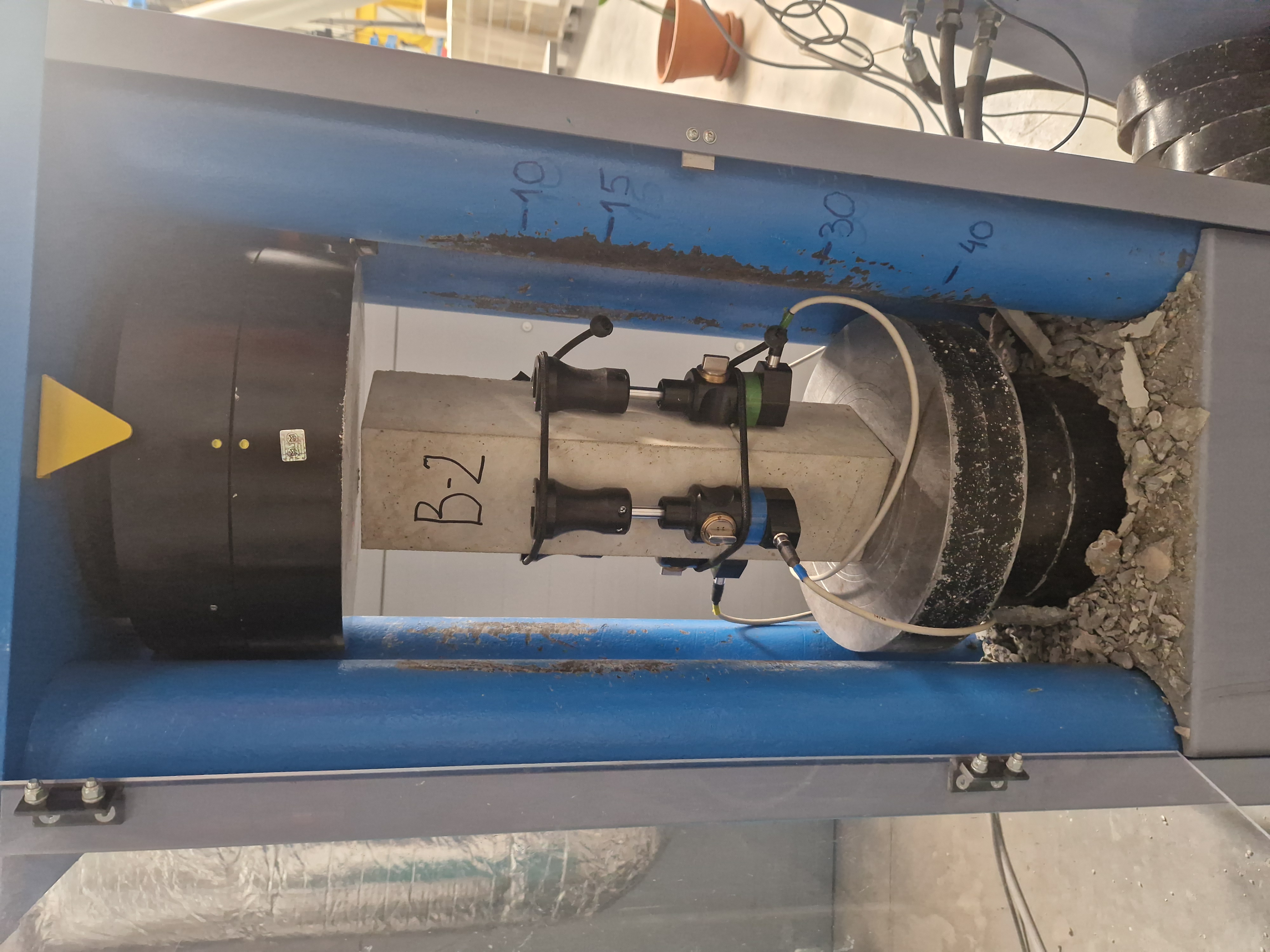
At the 28-day mark, the EVPRES team conducted a series of material characterization tests to evaluate the performance of our concrete samples.
One of the key procedures was modulus of elasticity testing. This test helps determine how concrete deforms under load — a critical parameter for both numerical simulations and modal analysis, where material stiffness directly influences dynamic response.
Accurate determination of these values ensures the reliability of our theoretical models and the validity of our experimental investigations.
July 2025 - Workshop on Data-Driven Intelligent Assessment of Bridge Infrastructure held at TUKE
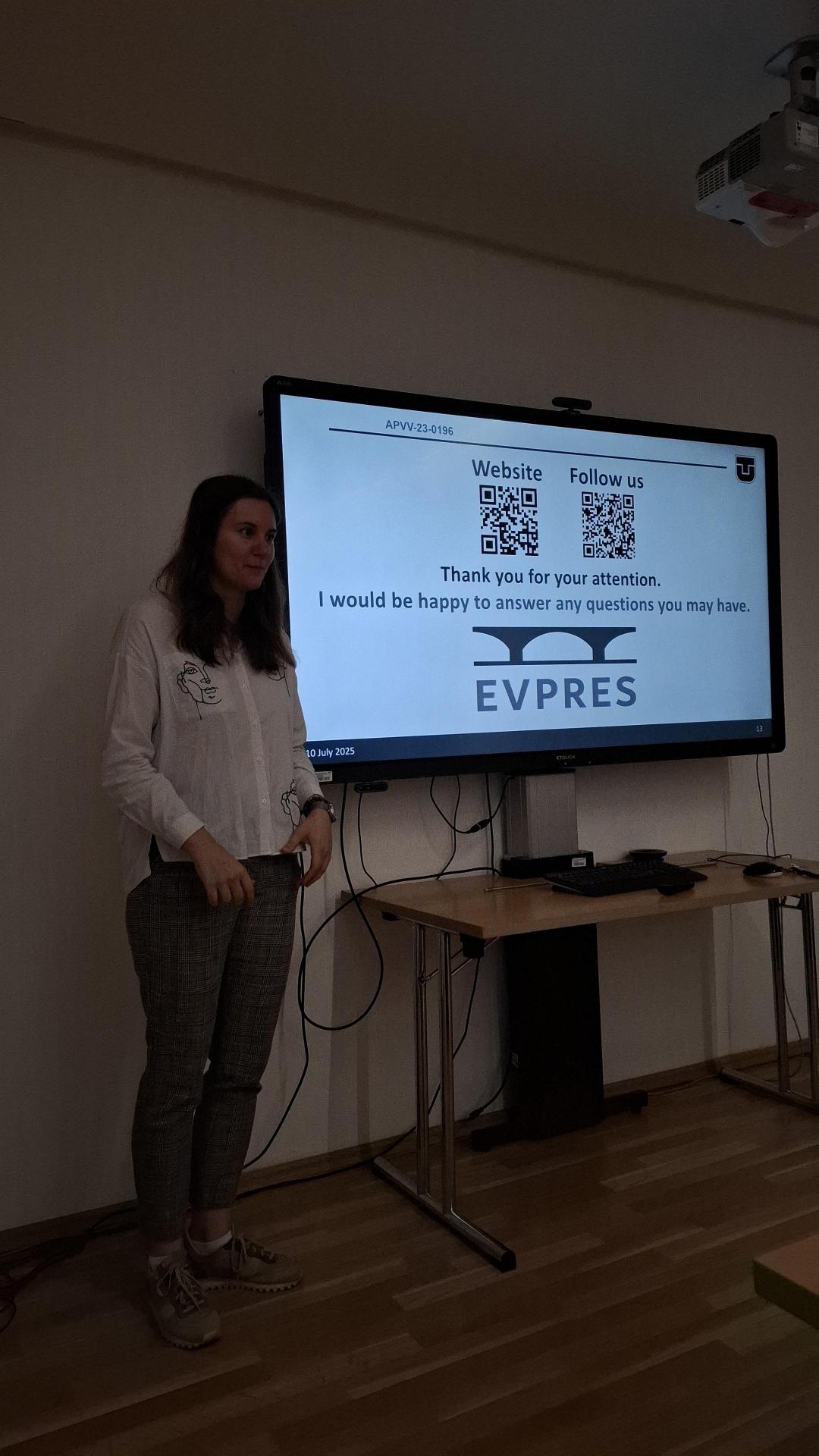
We’re happy to share that our recent research was presented at the workshop “Data-Driven Intelligent Assessment of Bridge Infrastructure” by Patrícia Vaňová, organized at Technical University of Košice!
July 2025 - EVACES Conference
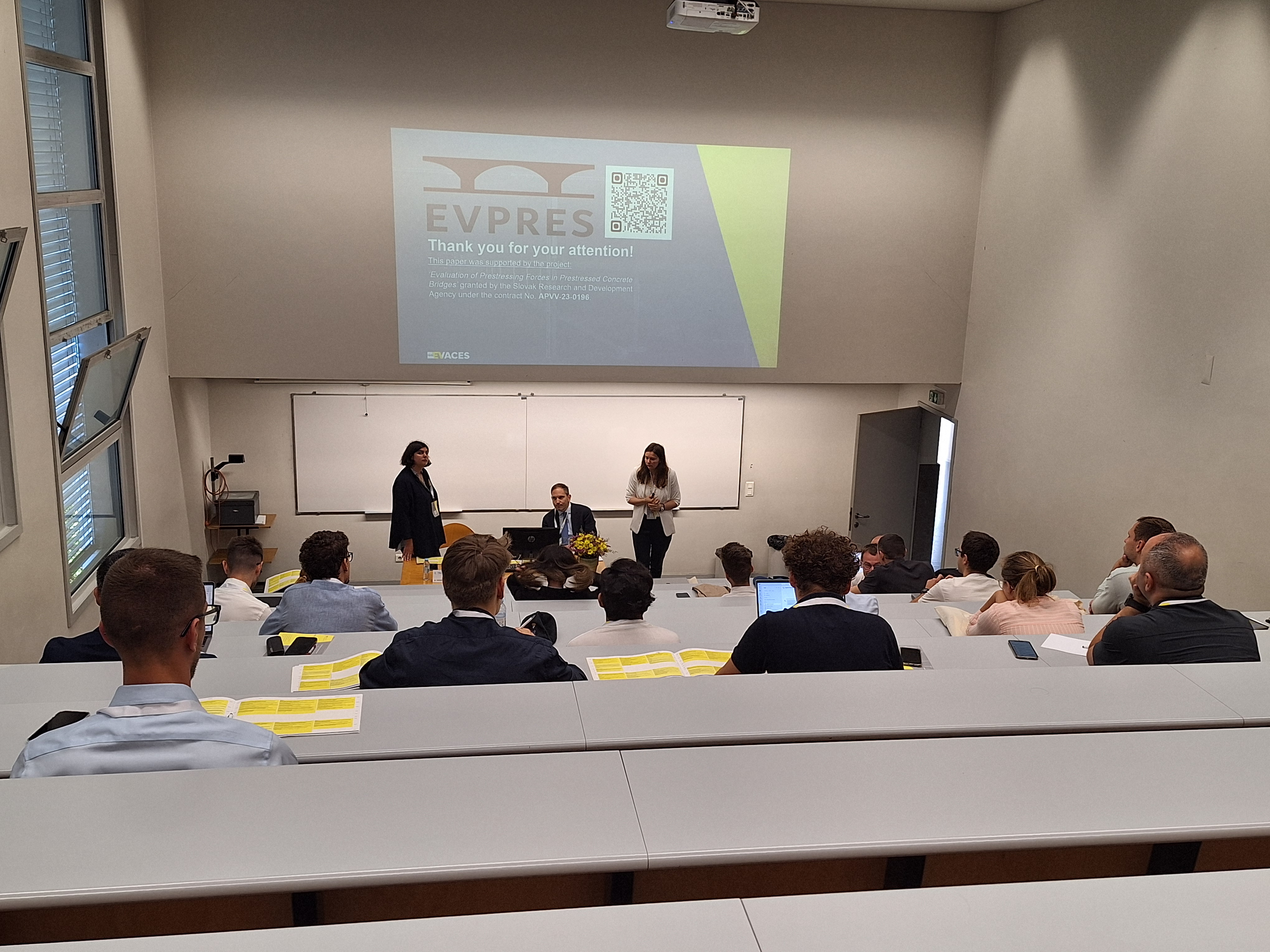
While waiting for our girders to arrive, we’ve been keeping busy with exciting research!
Using data from a previous study, we explored the potential of sparse autoencoders — a type of neural network designed to learn efficient, compressed representations — for damage detection in a model steel truss bridge.
We’re proud to see how insights from one research can inform and inspire progress in another.
June 2025 - Prestressed Concrete Girders Delivered
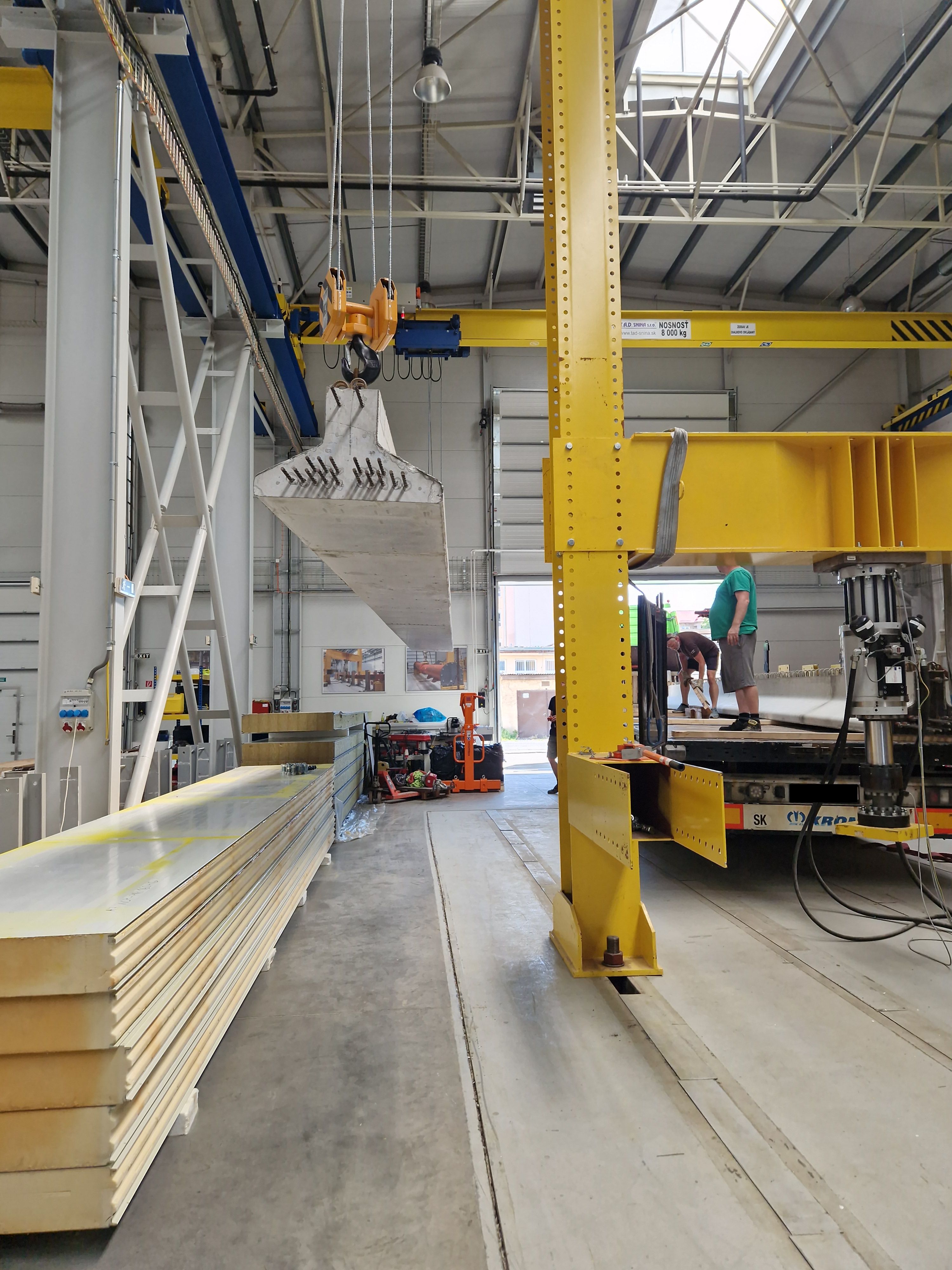
Just a few days after casting, our two prestressed concrete girders have been successfully delivered to our laboratory at Technical University of Košice!
This brings us one step closer to the experimental phase of our research. We’re excited to begin preparations for testing and to gather valuable data for structural health monitoring and analysis.
June 2025 - Milestone Achieved: Prestressed Concrete Girders Successfully Cast
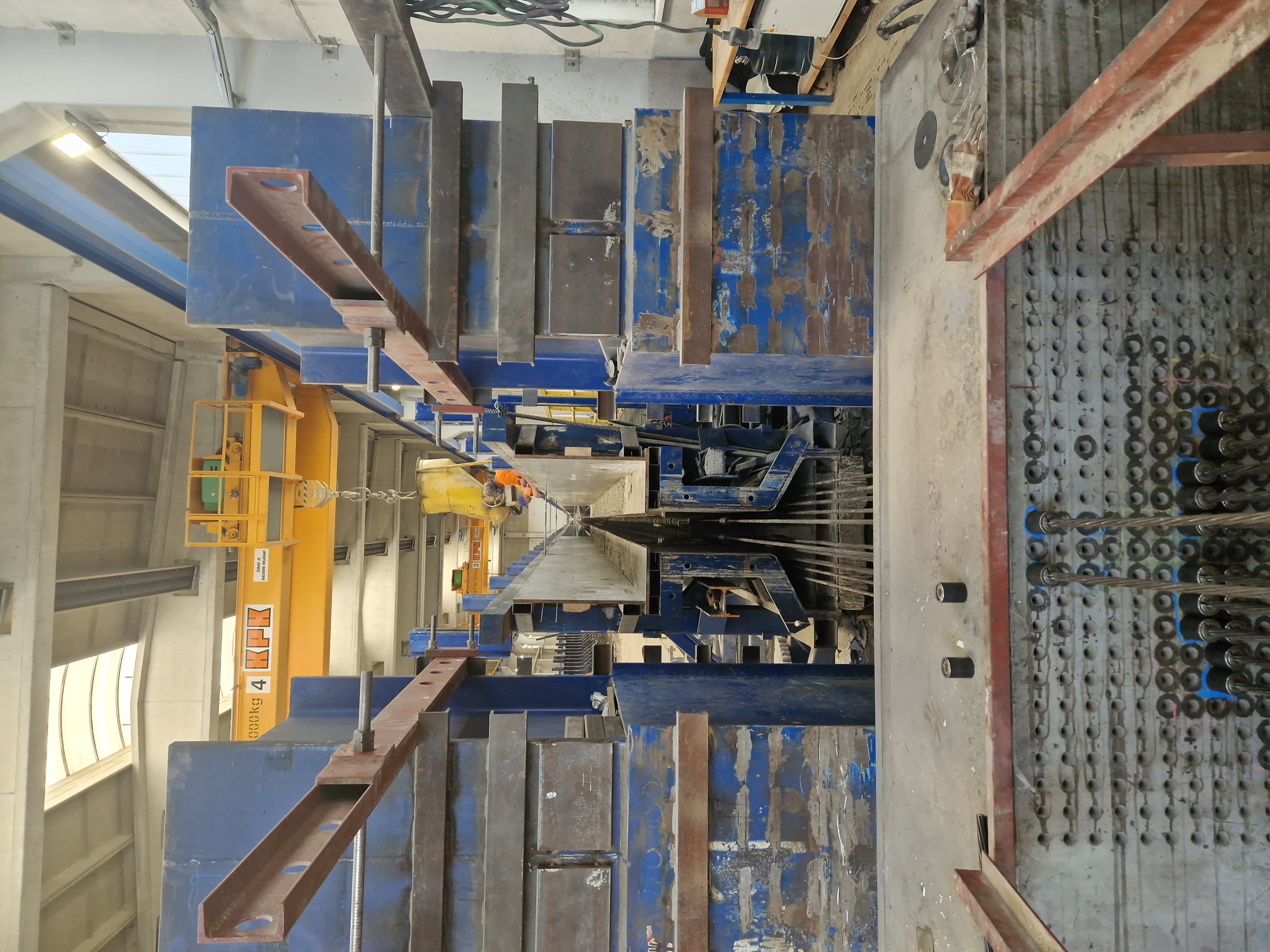
We’re excited to share a major achievement in our ongoing research project — the successful casting of our prestressed concrete girders.
This is a huge step forward in our research and development efforts, and we’re thrilled to see everything coming together. The team’s hard work and coordination are paying off, and we’re looking forward to the next phases of testing and analysis.
Stay tuned for more updates!
November 2024 - Workshop on Data-Driven Intelligent Assessment of Bridge Infrastructure
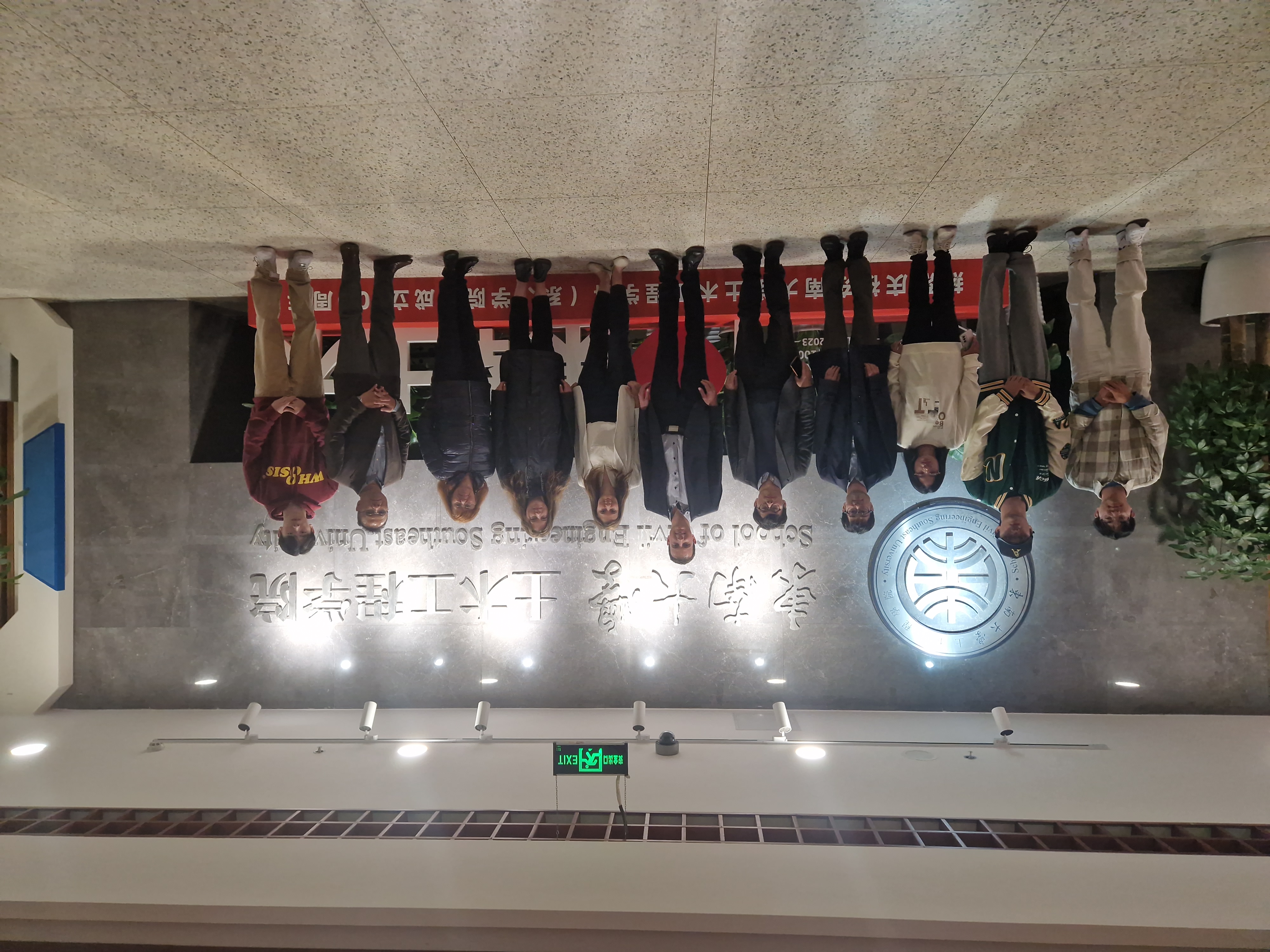
Last week, four members of our research team had the pleasure of attending a workshop on “Data-Driven Intelligent Assessment of Bridge Infrastructure,” part of a bilateral project supported by the Slovak Research and Development Agency under project no. SK-CN-23-0037. Organized by Professor Zhen Sun and hosted by the School of Civil Engineering at Southeast University in China, the workshop gathered experts to discuss structural health monitoring (SHM) of girder bridges using real-time data and the current conditions of bridges in China and Slovakia. The program also included a tour of the Structural Laboratory at Southeast University.
During the workshop, our team presented the newly funded project, “Evaluation of Prestressing Forces in Prestressed Concrete Bridges” (EvPres). We also had the opportunity to visit the Data Center for Long-Span Bridges in Jiangsu, and explore the monitoring of local infrastructure, including a prestressed concrete bridge and the Nanjing Dashengguan Yangtze River Bridge, where we observed the installation of monitoring sensors inside the structure.
This workshop provided an excellent platform for sharing knowledge, exchanging ideas, and identifying possibilities for future collaboration. We extend our gratitude to everyone involved in organizing and participating in this event!
October 2024 - Website Launched
We are excited to announce the official launch of our website! This platform will be the main hub for updates, news, and resources related to our project. Stay tuned for the latest developments!
September 2024 - Project Kickoff
The project officially started on September 1st, and we’re thrilled to begin this journey. Our team is hard at work setting the foundation for the goals outlined in our project objectives.