Research objectives
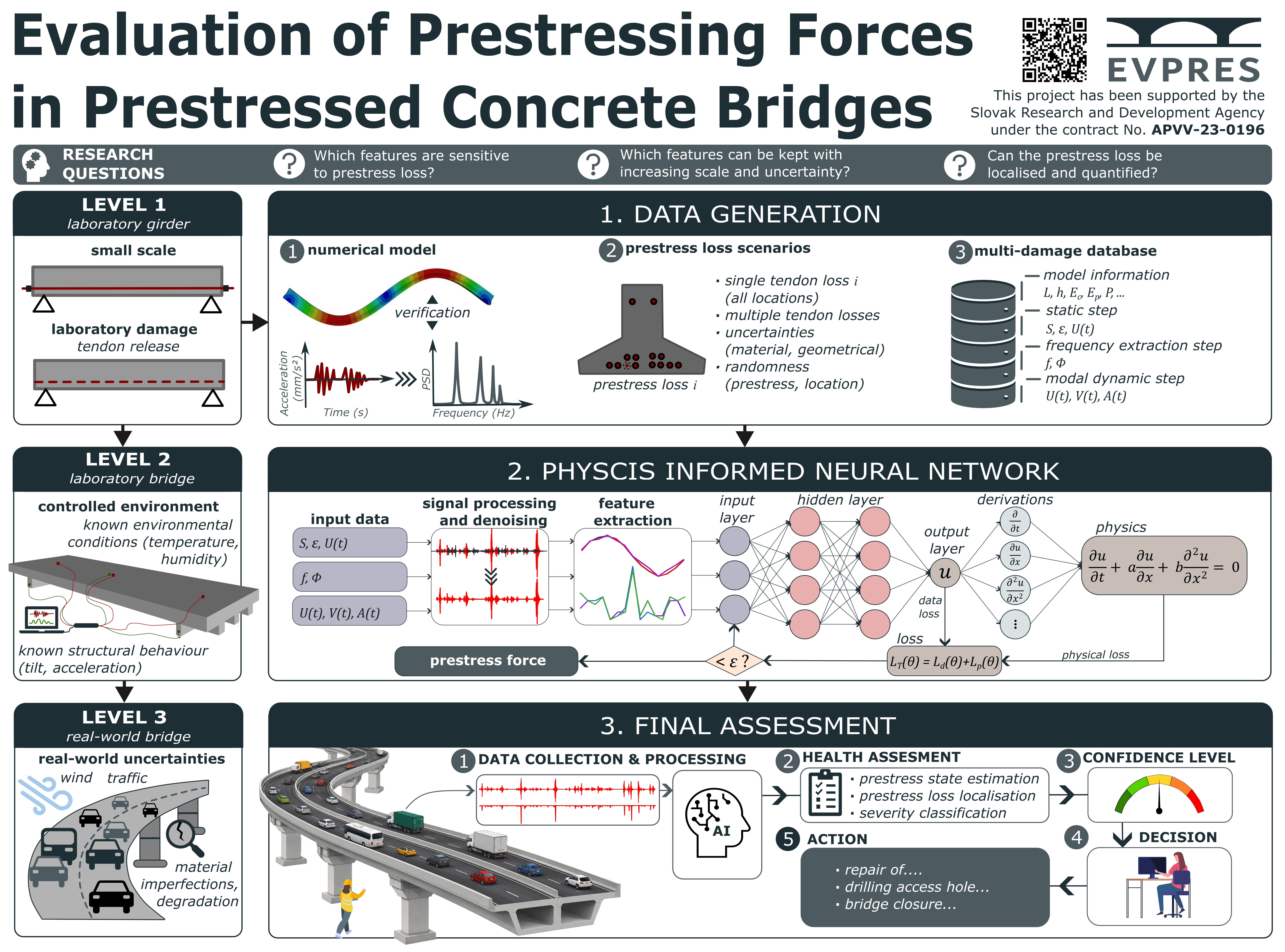
The overall goal of EvPres is to develop and validate a structural health monitoring (SHM) methodology for the identification and quantification of prestressing forces in prestressed concrete bridges, targeting an accuracy of 95%. The methodology will combine high-fidelity numerical modelling, experimental measurements, physics-based response analysis, and artificial intelligence to identify prestress-sensitive structural features and assess their robustness under increasing levels of uncertainty and structural complexity. The results will contribute to the condition assessment of prestressed concrete bridges in Europe and support the early detection of prestress-related deterioration, helping to reduce the risk of unexpected failure and unnecessary or premature bridge closure.
Based on the research gaps (RGs) identified in the current status of knowledge, the following research objectives (ROs) were determined:
- RG1 → RO1: o develop and experimentally validate a high-fidelity numerical model of a prestressed concrete girder, capable of reproducing its static and dynamic structural response for different prestress states.
- RG2 → RO2: To develop an SHM methodology for identifying and quantifying prestressing forces by investigating prestress-sensitive structural response features and their robustness to measurement noise, modelling uncertainties, and structural imperfections, using physics-based inverse identification and AI-based approaches.
- RG3 → RO3: To assess the transferability and performance of the developed SHM methodology at bridge scale through a numerical bridge model and diagnostic testing conditions, and to determine which prestress-sensitive features remain reliable with increasing structural complexity and uncertainty.